
Progress Report 2015
Enforcement & Stewardship

A Range of Enforcement Tools
EPA uses targeted inspections and an array of enforcement options to ensure compliance with federal environmental laws.
Working Together to Protect Communities »
Enforcement is an essential part of EPA's mission – an important responsibility shared with state, local and tribal partners. Together, robust enforcement programs enable us to better protect our communities from degradation caused by those who violate environmental laws.
At the federal level, EPA strives to ensure that communities across the region receive the same degree of protection from environmental violations. The agency can pursue violations through civil enforcement, or in more egregious situations, criminal enforcement.
EPA has authority to order facilities to comply with environmental requirements. In some cases, those orders are issued by the agency unilaterally, but more often are negotiated. Depending on the nature and scope of the violation, the agency may choose to assess a penalty as well.
EPA has both administrative authority – which allows the agency to issue orders and impose penalties directly – as well as judicial authority. For judicial cases, EPA partners with the Department of Justice to file actions in federal court.
In the end, successful enforcement of environmental laws depends on strong state, local and tribal programs together with focused, appropriate federal responses to non-compliance.
Enforcement Cases Bring Results »
EPA's 2014 enforcement results were led by a $4.4 billion national settlement with Kerr-McGee Corp. and Anadarko Corp. that allocated more than $2 billion for cleanups of abandoned uranium mines on the Navajo Nation and a groundwater cleanup to protect Lake Mead and the Colorado River. More on this story »
An enforcement action against the East Bay Municipal Utility District (EBMUD) and seven East Bay communities committed $1.5 billion to eliminating sewage discharges into San Francisco Bay. Another enforcement settlement prevents pollution from a bayside scrap metal recycler. More on this story »
A settlement with Costco, one of the nation's largest retailers, will cut its emissions of ozone-depleting and greenhouse gas chemicals from refrigeration equipment at 274 of its stores.
 AllenCo has been ordered to improve safety measures at its oil facility in residential South Los Angeles.
An EPA inspection of AllenCo, a small oil production operation that generated complaints in a residential neighborhood of Los Angeles, found violations of federal Clean Air, Clean Water, and Community Right to Know laws. The facility voluntarily shut down, entered into a consent agreement to make improvements before reopening, and paid a $99,000 penalty.
In San Pedro, EPA found violations of risk management plan regulations at a propane and butane storage facility, Rancho LPG, near a residential area. To settle the enforcement action, Rancho LPG invested more than $7 million in new safety controls, tank inspections, seismic upgrades, and improved coordination with emergency responders, and paid a $260,000 penalty.
In Hawaii, EPA found that rental property owner Destination Maui had failed to notify tenants about lead-based paint in their units. To settle the case, the firm is buying blood lead analysis equipment for three health clinics and funding the testing of 350 children. In Northern California, EPA fined several small construction companies for lack of required certification as lead abatement contractors and for violating lead dust rules.
Supporting Research and Innovation
EPA funds research and development by universities and businesses with innovative ideas for less toxic, healthier-to-use materials, fuels and products.
Grants, Recognition Fuel Advances »
EPA's partnerships with educational institutions and small businesses are a key to ensuring future environmental progress.
Arizona State University received a $5 million EPA research grant to investigate the impacts and hazard potential of nanomaterials throughout their life cycle. Nanomaterials are less than 100 nanometers in size, too small to be seen with conventional microscopes.
University of California at Santa Barbara received a $4.9 million grant to develop an online tool to evaluate life-cycle impacts of chemicals, to better inform industry decision-makers about chemical and product design.
U.C. Berkeley's Center for Green Chemistry received $115,000 to develop a course on using green chemistry techniques to solve real-world business problems. Students will help five companies reduce use of hazardous chemicals in their product and processes, and U.C. will share the results.
Southern California companies receiving Small Business Innovation Research grants for technology development include Biopico Systems for a portable testing system for water-borne pathogens, CLEW for a cost-effective household wastewater treatment and nutrient removal system, and AquaNano for a high-capacity perchlorate filter for drinking water treatment.
Amyris in Emeryville and Solazyme in South San Francisco won Presidential Green Chemistry Awards for creating plant-based fuels and oils. The Bay Area companies were among just five organizations honored nationwide. Amyris engineered a yeast to convert plant-based sugars into a renewable fuel to replace diesel, cutting 82% of greenhouse gas emissions. Solazyme developed renewable oils from sugar and engineered microalgae that significantly reduce wastes, water and energy use compared to petroleum- or existing plant-based oils in soaps, detergents, food products and vehicle fuels.
Putting Safer Chemicals to Work »
The Custodial Green Cleaning program was developed by the San Francisco Department of the Environment under a $74,500 EPA pollution prevention grant. In 2014, EPA and the city honored five companies that completed the pilot program – the nation's first green business program focused on janitorial cleaning – reducing both building occupants' and custodial workers' exposure to harmful chemicals.
The goal is to prevent health problems such as asthma and other respiratory illnesses, eye and skin irritations and burns, and toxic exposure through inhalation of fumes.
At the start of the program, SF Environment found that one of the main barriers to use of safer cleaning chemicals was lack of training. They developed multi-lingual training videos and written materials, now available online. More than 300 custodians have been trained, eliminating the use of over 12,000 gallons of harmful cleaning chemicals each year.
www.epa.gov/greenchemistry | www.epa.gov/region9/mediacenter/greencleaning
Focus on Nevada
Years of enforcement work by EPA and the Department of Justice will help clean up chemical sites and polluted groundwater in Henderson, Nev.
$1.1 Billion for Henderson Perchlorate Cleanup »
The settlement of a nationwide enforcement case with Kerr-McGee Corp. and Anadarko Corp. has secured $1.1 billion to clean up a former Kerr-McGee chemical manufacturing site that has been contaminating Lake Mead with perchlorate, a component of rocket fuel.
The Kerr-McGee site in Henderson, Nev., near Las Vegas, has the nation's largest plume of groundwater contaminated with perchlorate. The contaminated groundwater flows into Lake Mead, a drinking water source for 15 million people in Nevada, Arizona and Southern California.
The Nevada Division of Environmental Protection began the cleanup several years ago and has removed more than 4,000 tons of perchlorate from the soil and groundwater. Perchlorate can interfere with the production of thyroid hormones, which are needed for prenatal and postnatal growth and development, as well as for normal metabolism and mental function in adults.
The settlement, which covers Kerr-McGee sites in 47 states, sets aside $4.4 billion for environmental cleanup, including $985 million for uranium mining sites on and around the Navajo Nation. More on this story »
Parts Manufacturer to Clean Up PCBs »
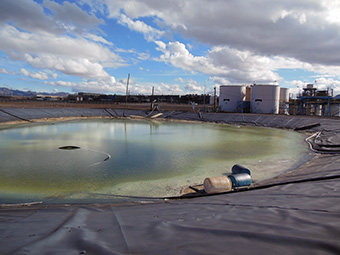 A lined pond at the Tronox facility in Henderson, Nev., still contains residual perchlorate from the pond's former use in the manufacturing process.
In April 2014, Titanium Metals Corporation, also known as TIMET, agreed to pay a record $13.75 million civil penalty and perform an extensive investigation and cleanup of potential contamination stemming from unauthorized manufacture and disposal of toxic PCBs (polychlorinated biphenyls) in Henderson, Nev.
The penalty was the largest ever imposed for violations of the Toxic Substances Control Act (TSCA) at a single facility. EPA inspections revealed that TIMET had been unlawfully manufacturing PCBs as a by-product, without an exclusion from TSCA's ban.
EPA expects the settlement to result in the removal of 84,000 pounds of PCB-contaminated waste from the environment and prevent the improper disposal of 56 million pounds of hazardous waste each year.
This settlement was part of EPA's nationwide enforcement initiative to reduce pollution from mining and mineral processing, which can generate large volumes of toxic and hazardous waste.
facilities inspected by
EPA in the Pacific Southwest in FY14
EPA Spotlight
DR. HONG JIAO

Berkeley, Calif., scientist Dr. Hong Jiao won a $300,000 EPA Small Business Innovation Research (SBIR) competitive grant in 2014 to build a cheap, portable water testing device to protect swimmers, children and animals from toxic algae blooms in fresh water.
Cyanotoxins from toxic algae can damage the liver or nervous system. In early 2015, three dogs died after swimming through toxic algae in Alameda County's Lake Chabot.
Dr. Jiao's company, HJ Science & Technology, is using "lab-on-a-chip" technology for monitoring cyanotoxins. The company is testing the device at Pinto Lake (near Santa Cruz), which has been plagued with toxic algae.