
Progress Report 2015
Clean Air

A Clearer Future for San Joaquin
California's San Joaquin Valley is taking steps to create a healthier environment while modernizing its infrastructure. High-speed rail promises to benefit both public health and the valley's economy.
Fighting Air Pollution in the Valley »
 EPA Administrator Gina McCarthy, California Governor Jerry Brown and other officials celebrate the start of construction on the high-speed rail project.
On January 6, 2015, EPA Administrator Gina McCarthy met with Governor Jerry Brown, Mayor Ashley Swearengin, and other government and transportation leaders in Fresno, Calif., to mark the start of sustained construction on what is anticipated to be the nation's first truly high-speed rail system.
In 2029, the zero-emission electric train is expected to run from San Francisco to Los Angeles in under three hours – the fastest, most environmentally-friendly way to travel between the state's biggest urban areas and within the San Joaquin Valley.
Construction on the rail line will use the cleanest EPA-certified equipment, create jobs and stimulate the valley's economy.
The San Joaquin Valley has some of the nation's toughest air quality challenges. It's a major transportation corridor for heavy-duty trucks, which emit diesel particulate and black carbon pollution.
EPA continues to work with the California Air Resources Board and San Joaquin Valley Unified Air Pollution Control District to help reduce pollution from a full range of pollution sources that contribute to the valley's unhealthy air and high rates of childhood asthma.
Cleaning Up Diesel Engines »
For the past 10 years, EPA has partnered with dozens of federal, state and local public and private partners in the West Coast Collaborative (WCC) to reduce diesel emissions, including black carbon and greenhouse gases, with innovative and proven technologies.
Through the WCC, EPA has provided and leveraged approximately $20 million in funding under the Diesel Emissions Reductions Act (DERA) and other public and private sources to retrofit and replace more than 500 old diesel engines throughout the San Joaquin Valley with clean diesel, natural gas, and electric engines for trucks, buses, agriculture equipment and locomotives.
The U.S. Department of Agriculture has helped replace more than 2,000 high-emitting tractors in the valley, including over 130 engines in 2014 alone.
Since 2008, EPA has collaborated with the California Air Resources Board and the San Joaquin Valley and South Coast air districts on the Clean Air Technology Initiative (CATI), which seeks to accelerate the demonstration and deployment of zero- and near-zero-emission technologies.
In 2014, EPA awarded $500,000 in CATI grants to support San Joaquin's Technology Advancement Program and $500,000 to the South Coast to develop Trans Power battery-electric yard trucks for demonstration at distribution centers and rail yards, and to demonstrate in-cabin air filtration systems on school buses.
www.hsr.ca.gov | www.westcoastcollaborative.org | www.epa.gov/region9/cleantech
Understanding Roadside Air Quality
Proximity to roadways can be linked to health problems, including childhood asthma and increased risks of lung and heart disease.
Monitors Help Assess Risk »
Air pollutants from cars, trucks and other motor vehicles tend to be at their highest levels within 500-600 feet of a heavily-traveled roadway. Particulate emissions from diesel trucks can be especially harmful. To better understand the health risks, EPA now mandates air monitoring for near-road air pollution in metropolitan areas.
New monitoring sites in five Pacific Southwest cities – Oakland, San Jose, Anaheim, and Ontario in California and Tempe in Arizona – were operational by the end of 2014.
Eight more cities – Long Beach, Sacramento, Berkeley, Fresno, Bakersfield, and San Diego in California, Las Vegas in Nevada, and Phoenix in Arizona – are being added in 2015.
With more than 45 million people in the U.S. living, working, or attending school within 300 feet of a major road, airport or railroad, there is growing concern about the health impacts of roadway traffic. To build awareness of health risks and ways to reduce exposure, EPA developed outreach materials and tools geared for schools and land-use planners. In 2015, EPA will help schools in the Pacific Southwest identify best-practice strategies to reduce exposures.
EPA is also working with state and local partner agencies, as well as community advocates, as they develop methodologies and guidelines for assessing and mitigating near-roadway impacts in the development of regional and local land use, transportation and freight transport plans.
At the U.S.-Mexico border crossing in San Ysidro, Calif., EPA provided funding to the San Diego County Air Pollution Control District to purchase, install and operate an air pollution monitor to measure levels of fine particulate pollution. More on this story »
Focus on Arizona
Air quality issues in Arizona range from the haze obscuring national parks to the impact of underground contamination in residential areas.
Large Industrial Facilities Cut Emissions »
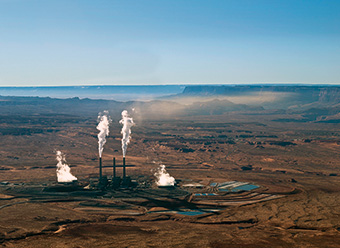 Navajo Generating Station, a 2,250-megawatt coal-burning electric power plant 20 miles from Grand Canyon National Park, will reduce its NOx and SO2 emissions. Photo: Ted Grussing
Arizona's national parks and wilderness areas have been in countless Hollywood Westerns showing iconic vistas of desert rock formations and clear skies stretching to far-off horizons. In recent decades, however, visitors and residents have often found hazy skies, due in part to unhealthful emissions from industrial facilities in Arizona.
In 2014, EPA finalized new pollution control requirements at these facilities, which will improve visibility at 21 national parks and wilderness areas. One of the sources, Navajo Generating Station (NGS), a 2,250-megawatt coal-burning power plant on the Navajo Nation, is just 20 miles from the eastern boundaries of Grand Canyon National Park. Under EPA's final plan, NGS, currently one of the nation's largest sources of smog-forming nitrogen oxide (NOx) emissions, will reduce its NOx pollution by over 80%.
The proposed requirements on NGS sparked widespread public interest and involvement. Before finalizing the action, EPA held five public hearings and more than 50 consultation meetings with Indian tribes, and considered 77,000 comments from the public.
In addition to NGS, EPA's actions will also reduce NOx and sulfur dioxide (SO2) emissions from Tucson Electric Power's Sundt Plant, Chemical Lime Nelson in Peach Springs, ASARCO's Hayden Smelter, Freeport McMoRan's Miami Smelter, Phoenix Cement Company's Clarkdale plant and CalPortland Cement's Rillito plant.
All told, these actions will reduce both SO2 and NOx emissions by a total of 31,000 tons per year, protecting public health, clearing skies, and helping the region transition to cleaner power.
Investigating Vapor Intrusion in Phoenix »
At the Motorola 52nd Street Superfund site in Phoenix, treatment of contaminated groundwater has been underway since 1992.
Since 2011, EPA has also investigated a possible health issue: vapor from groundwater contaminated with toxic trichloroethylene (TCE) rising through the soil into residential and commercial buildings in some areas of the site. So far, EPA has installed mitigation systems in 15 homes near the site to remove TCE from the indoor air.
In 2014, EPA brought in a mobile laboratory to do real-time testing and analysis of indoor air and soil gas. Forty-nine temporary soil vapor wells were installed and sampled, identifying areas where vapor intrusion could be occurring and where further monitoring or mitigation might be needed. As a result, eight homes and two commercial buildings were sampled.
Investigators gathered data on short-term exposures, determined the effectiveness of mitigation systems in some of the homes, and gained better understanding of where further monitoring is warranted. This is vital because of the short-term health effects of TCE in fetal heart development in the early stages of pregnancy.
Continuing monitoring and investigation of indoor vapor intrusion will help inform decisions about where additional indoor air mitigation systems may be needed throughout the Motorola 52nd St. site.
EPA Spotlight
Deborah Jordan

In December 2014, President Obama presented EPA regional Air Division Director Deborah Jordan with the Presidential Rank Award, a rare honor given only to the federal government's most outstanding senior executives.
For more than a decade, Jordan has led the Region's ongoing efforts for clean air. Her accomplishments include finalizing the regional haze plan to improve visibility at the Grand Canyon and launching the West Coast Collaborative, a partnership that has spurred 500 projects to reduce diesel emissions.
During her tenure, EPA has taken more than 500 rule-making actions on California's air quality plans and rules, reducing smog by 20% in the South Coast area and San Joaquin Valley.