
Progress Report 2015
Climate & Communities

Greening Infrastructure
EPA applauds the work of local governments and businesses that are managing their materials through innovative practices to reduce greenhouse gas emissions.
Communities Act Locally on Climate »
As work continues to secure national and international commitments to reduce greenhouse gas emissions, some local governments in the Pacific Southwest have deployed innovative technologies to green their own infrastructure, creating examples for other municipalities.
San Jose, Calif., now boasts a facility that digests the city's food waste to create biogas and compost, generate electric power, and prevent emissions of methane, the potent greenhouse gas generated when food goes into a landfill.
This is the nation's first – and the world's largest – commercial, dry-fermentation anaerobic digestion facility, owned and operated by Zero Waste Energy Development in partnership with the City of San Jose. The city currently diverts about 74% of its waste from landfills through reuse, recycling, composting, and anaerobic digestion. Its goal is zero waste by 2022.
At the facility, bacteria break down the food and organic matter in 16 digesters, creating methane. The gas is captured to fuel a combined heat and power plant, generating electricity for adjacent recycling operations. The facility can digest 90,000 tons of organic waste per year and generate 1.6 megawatts, enough to sell excess power to the grid. The solid residuals left after digestion are composted onsite to create a valuable soil amendment.
The Victor Valley Wastewater Reclamation Authority (VVWRA), started up a new facility in September that is soon expected to generate 100% of the regional wastewater treatment plant's power from co-digesting sewage sludge and food waste. The VVWRA retrofitted a shuttered anaerobic digester with new technology that increased the amount of organic waste it can handle. The resulting project is expected to replace 9 million kwh of electricity annually – equivalent to taking more than 2,000 cars off the road – and keep 1,400 tons of waste from entering landfills each year.
Phoenix worked with the Arizona Super Bowl Host Committee and the National Football League to achieve a 73% waste diversion rate at this year's Super Bowl festivities. Of that amount, 32% was composted in a pilot food waste and composting program – part of a larger effort to bring curbside collection of food and yard waste and a state-of-the-art composting facility to Phoenix.
Food Recovery Challenge and New Toolkit Help Reduce Waste »
EPA's Food Recovery Challenge and new Reducing Wasted Food and Packaging Toolkit encourage businesses and organizations to reduce food waste and help feed people in need.
In the Pacific Southwest, challenge participants prevented 847 tons of wasted food, donated more than 55,000 tons and diverted more than 61,000 tons for composting, anaerobic digestion and biofuels production in 2013. The resulting reduction in greenhouse gas emissions was equivalent to taking 10,000 cars off the road.
www.epa.gov/foodrecoverychallenge | www.epa.gov/region9/organics/foodtool
Support for Border Communities
Grants help reduce water pollution, recycle e-waste, and monitor air quality in heavily-populated border areas. Local Residents Benefit in U.S., Mexico.
Local Residents Benefit in U.S., Mexico »
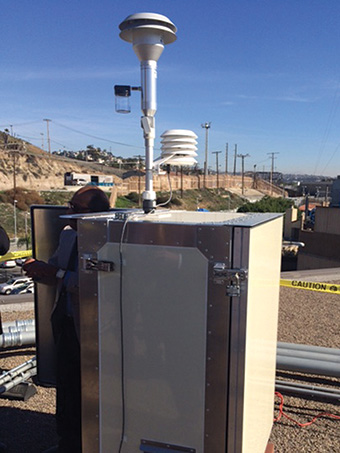 An air monitor measures particulate air pollution in San Ysidro, Calif., at the nation's busiest border port of entry.
EPA Administrator Gina McCarthy traveled to San Diego in October 2014 to announce more than $8.6 million in grants for environmental improvements along the U.S.–Mexico border.
The EPA funds were awarded in partnership with the North American Development Bank (NADBank) and the Border Environment Cooperation Commission (BECC). The grants included:
- $5 million to the NADBank for drinking water and wastewater projects to be selected by EPA and the BECC
- $3.5 million to the city of Holtville, Calif., to upgrade its wastewater treatment plant, reducing ammonia discharges to the Salton Sea
- $65,000 to the Sonoran Institute, based in Tucson, Ariz., to clean and restore a segment of the New River in Mexicali, and launch community efforts to prevent illegal dumping
- $49,180 to the California Department of Public Health to assess environmental health disparities, prioritize needs along the border, and target future environmental health efforts
Four months later, Regional Administrator Jared Blumenfeld unveiled a new air monitoring station at the San Ysidro, Calif., border crossing. On average, 50,000 cars and buses and 25,000 pedestrians a day cross at San Ysidro, the Western Hemisphere's busiest land port of entry. Air pollution from vehicles affects communities on both sides of the U.S.-Mexico border.
The new air monitor, funded by a $110,000 EPA grant to the San Diego County Air Pollution Control District, collects data on fine particles (PM2.5) from engine emissions. Health studies have shown a significant association between exposure to fine particles and premature death from heart or lung disease.
Focus On Hawaii and Pacific Islands
Educational efforts in the Pacific complement core environmental programs.
Recognizing Educators »
Kokua Hawaii Foundation and founder/executive director Kim Johnson were recognized by EPA for the organization's work in schools to encourage recycling and environmental stewardship. Their farm-to-school and plastic-free initiatives teach students the value of taking care of their health and the health of the Hawaii environment.
The Plastic-Free Schools program provides resources, tools and trainings to educate school communities on the environmental and health benefits of going plastic-free, to minimize plastic pollution in Hawaii.
EPA also funded two fellowship grants to two graduate students at the University of Hawaii-Manoa for research on the effects of water pollution and climate change on coral reefs. Each will receive $84,000 for two years of research. The projects are:
- Investigating the relationship between land-based sources of pollution and coral reef ecosystem function;
- Acclimatization of Coral Populations to Local and Global Stressors: Can Corals Adapt to Future Threats?
Melanie Blas, a science teacher at Simon A. Sanchez High School in Guam, received EPA's Presidential Innovation Award for Environmental Education. Seventeen teachers and 60 students from across the nation were honored for promoting environmental education and stewardship. The teachers each received $2,500 to further their professional training, and their schools each received an additional $2,500 for environmental education programs.
Supporting the Outer Pacific Islands »
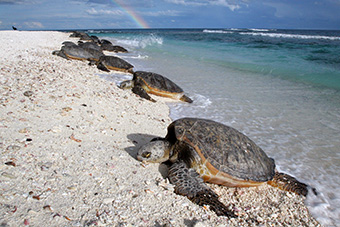 Green sea turtles haul out at Tern Island, an uninhabited islet in the Hawaiian Islands National Wildlife Refuge. Photo: Joe Spring
In September 2014, EPA and the U.S. Fish and Wildlife Service released an initial assessment of contamination at Tern Island, a remote island in the chain of Northwestern Hawaiian Islands. The results show that there have been releases of toxics, including polychlorinated biphenyls (PCBs) and lead, from military wastes buried on the island between World War II and 1979, and that further action is warranted.
The island, 564 miles northwest of Honolulu, is part of the Hawaiian Islands National Wildlife Refuge. It provides habitat for endangered monk seals, sea turtles, and many species of seabirds.
EPA in 2014 awarded over $32 million to Guam, American Samoa and the Commonwealth of the Northern Mariana Islands (CNMI, which includes Saipan), including $25 million to improve drinking water and wastewater service. The remaining $7 million funds local environmental protection work – including inspections, monitoring the safety of beaches, and drinking water, permit issuance, enforcement and other environmental programs.
In 2013, Guam's recycling rate jumped to 32%, from 18% as first reported in 2011 and 28% in 2012. In addition, Guam EPA opened its first household hazardous waste drop-off facility. It's free for island residents and designed to keep household hazardous waste out of Guam's new landfill.
The CNMI Bureau of Environmental and Coastal Quality issued a Climate Change Vulnerability Assessment for Saipan, the first for a U.S. insular area. In American Samoa, the LEED Platinum-certified AS-EPA building, funded in large part by U.S. EPA, became in 2014 one of fewer than two dozen buildings in the world to be certified as "net zero" for energy. AS-EPA's power bill went from more than $60,000 per year to essentially zero.
cars and buses cross the
San Ysidro Port of Entry each day
EPA Spotlight
Kara Brundin Miller

Kara Miller, since 2001 the elected chair of the Smith River Rancheria of the Tolowa Indian Tribe on California's North Coast, recently served on EPA's nationwide Local Government Advisory Committee. Miller is also a small business owner and a prominent member of the local farming community.
Drinking water and waste water systems on the rancheria have improved dramatically during Miller's tenure as chair. Her tribal community has tackled issues of sustainability and integrated water quality planning to balance economic development and protection of the wild salmon populations critical to the tribe and the Smith River ecosystem.