
Jump to main content or area navigation.

Contact Us

ReefLink Database

Shipping, Storage, & Warehousing

Shipping, Storage, & Warehousing

Shipping, Warehousing, and Storing pertains to the transportation and safe storage of goods for wholesale or retail trade.

CMap
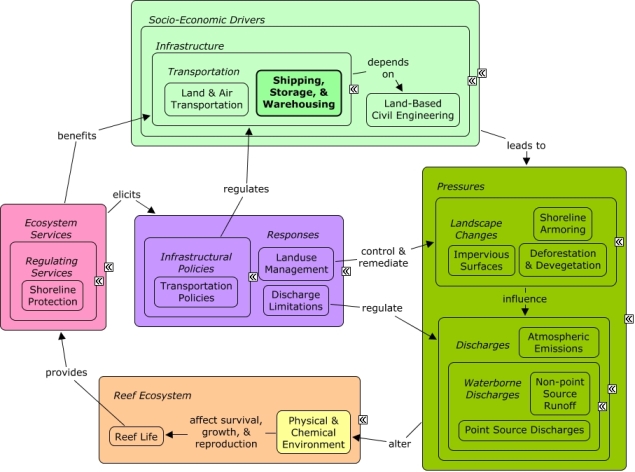
Atmospheric Emissions include discharges of atmospheric pollutants, including mercury, greenhouse gases, nitrogen and sulfur dioxides, and volatile organic compounds from the operation of factories, vehicles, and other sources. Deforestation and Devegetation are the removal of trees and plants, including clear-cutting, to provide clear land for farms, roads, homes, buildings, and other infrastructure. Discharge limitations are responses to regulate and control the discharge of pollutants and the use of chemicals. Discharges are the intentional or unintentional distribution of chemicals, debris, or other pollution, into the environment as a consequence of human activities. Ecosystem services are the benefits people obtain from ecosystems . Impervious surfaces are surfaces, such as asphalt roads and concrete sidewalks. Infrastructural policies are responses, including zoning, codes, or regulations, that impact the distribution and functioning of socio-economic sectors that provide infrastructure. Infrastructural sectors provide the physical, organizational, and technical support for the economy to function, including construction, utilities, transportation, finance, manufacturing, wholesale and retail trade, and technical services. Land and Air Transportation involves transportation of goods and people by either land or air. Land-Based Civil Engineering includes the design, construction, and maintenance of  engineering projects that provide physical public infrastructure, including highways, dams, and utility lines. Landscape Changes are alterations of the natural landscape through human activities, including coastal development, shoreline armoring, impervious surfaces, deforestation, or soil disturbance, which can alter water flow patterns and lead to pollutant runoff into coastal systems. Landuse management pertains to responses that determine the use of land for development and construction. Non-point source pollution is runoff from diffuse sources that is caused by rainwater moving over and through the ground, carrying pollutants with it and depositing them in coastal waters. The Reef Ecosystem includes a suite of abiotic variables that form the physical and chemical environment. Waterborne point source discharges are pollution from a discernible, confined conveyance, such as a pipe, vehicle, ship, or animal feeding operation that directly enter the aquatic environment into streams or direct discharge into coastal waters. Pressures are human activities that create stress on the environment. The state of the Reef Ecosystem is the condition, in terms of quantity and quality, of the abiotic and biotic components including physical, chemical, and biological variables. Reef Life is the abundance, distribution, and condition of the biological components of the coral reef ecosystem. Regulating Services are benefits obtained from ecosystem processes that regulate the environment, including erosion regulation, natural hazard regulation, and climate regulation. Responses are actions taken by groups or individuals in society and government to prevent, compensate, ameliorate or adapt to changes in Ecosystem Services or their perceived value. Shipping, Warehousing, and Storing pertains to the transportation and safe storage of goods for wholesale or retail trade. Shoreline armoring is the construction of bulkheads, seawalls, riprap or any other structure used to harden a shoreline against erosion. Shoreline Protection is the attenuation of wave energy by reefs that protects coastal communities against shoreline erosion and flooding during storms, hurricanes, and tsunamis that can cause property damage and loss of life. Socio-Economic Drivers include the sectors that fulfill human needs for Food & Raw Materials, Water, Shelter, Health, Culture, and Security, and the Infrastructure that supports the sectors. The Transportation Sector involves comprises all modes of transportation (Aviation, Maritime, Mass Transit, Highway, Freight Rail, and Pipeline) The Transportation Systems Sector is segmented into six key subsectors, or modes, which operate independently within both a regulated and non-regulated environment, yet are also highly interdependent. Transportation management includes policies, regulations, and zoning designed to control the distribution and intensity of transportation networks, including roads and shipping channels, and vehicles, including cars, boats, and ships. Waterborne discharges include direct and indirect discharges of pollutants into the aquatic environment, including chemicals, nutrients, sediment, and pathogens.

CMap Description

Growing coastal development leads to an increasing need for land & air transportation and shipping, storage, & warehousing facilities that contribute to landscape changes (including impervious surfaces, devegetation, and shoreline armoring for construction of roads and buildings), which can alter rates of pollutant runoff. Cars, trucks, airplanes, and trains also produce atmospheric emissions, including greenhouse gases. Land-based transportation sectors benefit from shoreline protection, as well as indirectly from other ecosystem services that improve the well-being of sectors, such as tourism & recreation, which drive coastal development. Transportation policies and landuse management through planning, permitting, and zoning can influence numbers, distribution, and technology airports, roads, parking lots, and other transportation infrastructure. Landuse restoration, such as hydroseeding along roads, can reduce runoff from impervious surfaces.

Citations

More than 50 citations. Click here to load.

Citation Year Study Location Study Type Database Topics

Management Options

Management Option Description Sources Database Topics
Corporate Response: Develop Outreach with Shipping Businesses This option requires the sanctuary to continue to alert shipping businesses about sanctuary regulations. Such regulations may include vessel waste discharge, ATBA, PSSA, etc. The targeted audiences will include importers, exporters, port authorities, commercial fishing companies, ship insurers. This information can be provided to the audience through NOAA nautical charts, trade publications, newsletters, trade shows, and direct mailings. NOAA Marine Sanctuary Program. 2007. Florida Keys National Marine Sanctuary revised management plan. National Ocean Service, Key West, FL.

Ballast Discharge; Boating Activities; Boating Regulations; Coastal Engineering; Collaboration & Partnering; Cultural Policies; Decision Support; Docks & Marinas; Environmental Education & Outreach; Finance & Insurance; Infrastructural Policies; Insurance; Manufacturing & Trade; Ports & Harbors; Shipping, Storage, & Warehousing; Transportation; Transportation Policies; Water Resources; Water Transportation; Waterborne Discharges

Laws

Legal Citation Purpose of Law Management Organization Database Topics

Jump to main content.