
ReefLink Database
Energy Policy & Development
Energy policy & development includes policies and regulations adopted to control the production, distribution, and consumption of energy. Examples include incentives for use of alternative energy sources, regulations on mining activities, and regulations on the oil and gas industry.
CMap
CMap Description
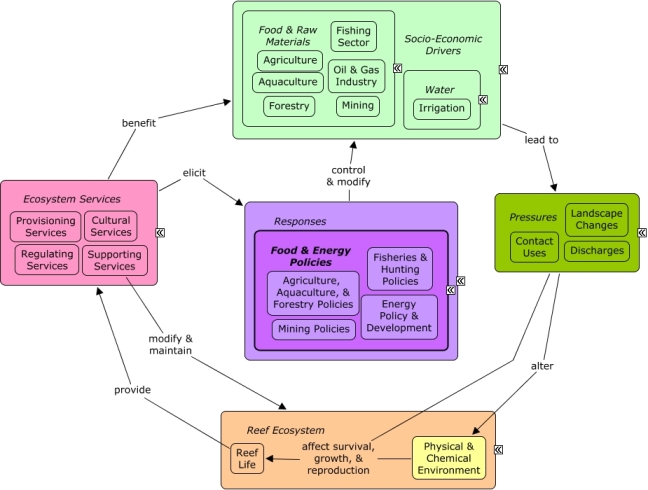
A change in the provision of ecosystem services, or a desire to improve provision of ecosystem goods such as seafood, may elicit responses to manage the distribution and functioning of food and energy sectors which create pressures on the reef environment. Energy management policies can be enacted to regulate mining activities to reduce erosion or discharge, or to limit the locations and activities of the oil and gas industry to reduce the risk of petroleum spills. Food & energy sectors benefit from reef ecosystem goods and services, in particular provisioning of finfish and shellfish.Citations
| Citation | Year | Study Location | Study Type | Database Topics |
|---|---|---|---|---|
| Armoza-Zvuloni, R; Segal, R; Kramarsky-Winter, E; Loya, Y. 2011. Repeated bleaching events may result in high tolerance and notable gametogenesis in stony corals: Oculina patagonica as a model. Marine Ecology Progress Series 426:149-159. | 2011 | Model | Climate; Stony Coral | |
| Andersson, M. H. and M. C. Ohman. 2010. Fish and sessile assemblages associated with wind-turbine constructions in the Baltic Sea. Marine and Freshwater Research 61:642-650. | 2010 | Artificial Habitat; Complex Habitat & Resources; Fish; Invertebrates | ||
| Beaudoin, G., D. Robertson, R. Doherty, D. Corren, B. Staby, and L. Meyer. 2010. Technological Challenges to Commercial-Scale Application of Marine Renewables. Oceanography 23:32-41. | 2010 | |||
| Bedard, R., P. T. Jacobson, M. Previsic, W. Musial, and R. Varley. 2010. An Overview of Ocean Renewable Energy Technologies. Oceanography 23:22-31. | 2010 | Europe | Salinity; Shoreline Protection | |
| Boehlert, G. W. and A. B. Gill. 2010. Environmental and Ecological Effects Of Ocean Renewable Energy Development A Current Synthesis. Oceanography 23:68-81. | 2010 | Review | ||
| Frank, W. J. 2010. The Role of the Minerals Management Service in Offshore Renewable Energy Development. Oceanography 23:60-67. | 2010 | Food & Energy Policies; Utility Policies | ||
| Konnert, T. 2010. The Role of the Federal Energy Regulatory Commission in Authorizing Hydrokinetic Technology Projects. Oceanography 23:54-59. | 2010 | Surface & Groundwater Flow; Utility Policies | ||
| Langhamer, O., K. Haikonen, and J. Sundberg. 2010. Wave power Sustainable energy or environmentally costly? A review with special emphasis on linear wave energy converters. Renewable & Sustainable Energy Reviews 14:1329-1335. | 2010 | Global | Review | Artificial Habitat; Fishing Sector; Shoreline Protection; Substrate; Whales & Dolphins |
| Mueller, M., H. Jeffrey, R. Wallace, and A. von Jouanne. 2010. Centers for Marine Renewable Energy in Europe and North America. Oceanography 23:42-52. | 2010 | Europe; England | ||
| Oran. C. and C. Marriott. 2010. Using Adaptive Management to Resolve Uncertainties for Wave and Tidal Energy Projects. Oceanography 23:92-97. | 2010 | Surface & Groundwater Flow | ||
| Portman, M.E. 2010. Marine Renewable Energy Policy: Some US and International Perspectices Compared. Oceanography 23:98-105. | 2010 | Germany; United Kingdom | Construction Codes & Projects; Food & Energy Policies | |
| Thresher, R. and W. Musial. 2010. Ocean Renewable Energy�s Potential Role in Supplying Future Electrical Energy Needs. Oceanography 23:16-21. | 2010 | Climate | ||
| Walther, A., I. Bjurhager, J.-M. Malho, J. Pere, J. Ruokolainen, L. A. Berglund, and O. Ikkala. 2010. Large-area, lightweight and thick biomimetic composites with superior material properties via fast, economic, and green pathways. Nano Letters 10:2742-2748. | 2010 | Lab Study; Model | Energy Policy & Development | |
| Andersson, M. H., M. Berggren, D. Wilhelmsson, and M. C. Ohman. 2009. Epibenthic colonization of concrete and steel pilings in a cold-temperate embayment: a field experiment. Helgoland Marine Research 12-Jan. | 2009 | Field Study & Monitoring | Artificial Habitat; Complex Habitat & Resources; Docks & Marinas; Fish; Oil & Gas Rigs; Tunicates | |
| Andersson, M. H., M. Berggren, D. Wilhelmsson, and M. C. Ohman. 2009. Epibenthic colonization of concrete and steel pilings in a cold-temperate embayment: a field experiment. Helgoland Marine Research 63:249-260. | 2009 | Field Study & Monitoring | Artificial Habitat; Complex Habitat & Resources; Docks & Marinas; Fish; Oil & Gas Rigs; Tunicates | |
| Anthony, K. R. N., M. O. Hoogenboom, J. A. Maynard, A. G. Grottoli, and R. Middlebrook. 2009. Energetics approach to predicting mortality risk from environmental stress: A case study of coral bleaching. Functional Ecology 23:539-550. | 2009 | US Pacific & Hawaii; Australia | Model | Climate; Stony Coral |
| Langhamer, O. and D. Wilhelmsson. 2009. Colonisation of fish and crabs of wave energy foundations and the effects of manufactured holes - A field experiment. Marine Environmental Research 68:151-157. | 2009 | US East Coast (NC, SC, GA); Atlantic Ocean; Europe | Field Study & Monitoring | Artificial Habitat; Complex Habitat & Resources; Fishing & Harvesting Management; Fishing Sector; Lobster, Crab, & Shrimp; Seastars; Shoreline Protection |
| Langhamer, O., D. Wilhelmsson, and J. Engstrom. 2009. Artificial reef effect and fouling impacts on offshore wave power foundations and buoys - a pilot study. Estuarine Coastal and Shelf Science 82:426-432. | 2009 | Artificial Habitat; Invertebrates | ||
| Omann, I., A. Stocker, and J. Jager. 2009. Climate change as a threat to biodiversity: an application of the DPSIR approach. Ecological Economics 69:24-31. | 2009 | Global | Decision Support Frameworks & Tools | Climate; Greenhouse Gas Emissions; Mitigation; Primary Production; Water Depth & Sea Level |
| Benson, B., A. Irturk, J. Cho, and R. Kastner. 2008. Survey of hardware platforms for an energy efficient implementation of matching pursuits algorithm for shallow water networks. Pages 83-86 in Proceedings of the Annual International Conference on Mobile Computing and Networking, MOBICOM. | 2008 | Field Study & Monitoring | Energy Policy & Development | |
| Hecht, A. D., D. Shaw, R. Bruins, V. Dale, K. Kline, and A. Chen. 2008. Good policy follows good science: using criteria and indicators for assessing sustainable biofuel production. Ecotoxicology | 2008 | Model; Index or Indicator | ||
| Schroder, P., R. Herzig, B. Bojinov, A. Ruttens, E. Nehnevajova, S. Stamatiadis, A. Memon, A. Vassilev, M. Caviezel, and J. Vangronsveld. 2008. Bioenergy to save the world: Producing novel energy plants for growth on abandoned land. Environmental Science and Pollution Research 15:196-204. | 2008 | Global; Europe | Field Study & Monitoring | Agriculture; Climate; CO2; Domestic Animal Waste; Greenhouse Gas Emissions; Nutrients; Water Depth & Sea Level |
| US Department of Energy. 2008. Establishing Baseline and Meeting Water Conservation Goals of Executive Order 13423. | 2008 | Review; Decision Support Frameworks & Tools | Energy Policy & Development; Food & Energy Policies; Transportation Policies | |
| Wijffels, R. H. 2007. Potential of sponges and microalgae for marine biotechnology. Trends in Biotechnology 26:26-31. | 2007 | Algae; Biotechnology Research & Development; Microorganisms; Pharmaceuticals & Cosmetics Sources; Sponges | ||
| Ashby, M. F. 2006. The properties of foams and lattices. Philosophical Transactions of the Royal Society A: Mathematical, Physical and Engineering Sciences 364:15-30. | 2006 | Model | Energy Policy & Development; Sponges | |
| Chatterjea, S., S. Kininmonth, and P. J. M. Havinga. 2006. Sensor networks. GEO: connexion 5:20-22. | 2006 | Australia | Collaboration & Partnering; Energy Policy & Development | |
| Hale, M. E., R. D. Day, D. H. Thorsen, and M. W. Westneat. 2006. Pectoral fin coordination and gait transitions in steadily swimming juvenile reef fishes. Journal of Experimental Biology 209:3708-3718. | 2006 | Corallivorous Fish; Energy Policy & Development; Fish; Large Herbivorous Fish; Small Herbivorous Fish | ||
| Minerals Management Service. 2006. Leasing Oil and Natural Gas Resources. U.S. Department of the Interior. | 2006 | South & Central America; India; Mexico | Monetary Valuation; Natural Gas & Electric Power; Special Use Permitting; Utility Policies | |
| de Koning, J. and S. Thiesen. 2005. Aqua Solaris - An optimized small scale desalination system with 40 litres output per square meter based upon solar-thermal distillation. Desalination 182:503-509. | 2005 | Model | Deforestation & Devegetation; Energy Policy & Development; Pathogens | |
| Kolian, S. and A. Walker. 2004. Louisiana is losing critical reef habitat and job opportunities. Sea Technology 45:31-34. | 2004 | Agriculture; Aquaculture; Artificial Habitat; Complex Habitat & Resources; Fish; Fishing Sector; Oil & Gas Rigs; Pathogens; Pharmaceuticals & Cosmetics; Pharmaceuticals & Cosmetics Sources; Pipelines; Tourism & Recreation | ||
| Suzuki, R. O., K. Tatemoto, and H. Kitagawa. 2004. Preparation of hydrogen storage alloys from the oxides by calcium co-reduction in molten CaCl2. Page 2470 in Meeting Abstracts. | 2004 | |||
| Thomas, F. R. 2003. Kiribati: \Some aspects of human ecology,\" forty years later". Atoll Research Bulletin Jan-40. | 2003 | Global; US Pacific & Hawaii; Kiribati | Agriculture; Finfish Harvest; Fisheries & Hunting Policies; Fishing Sector; Infrastructure; Resource Use Management | |
| Hower Amy, E. 1998. Combining wave energy and artificial reef technology for sustainable coastal resource development. Pages 1691-1695 in Oceans Conference Record (IEEE). | 1998 | Review | Artificial Habitat; Commercial Fisheries; Dive, Snorkeling, & Swimming Tourism; Drinking Water Supply; Finfish Harvest; Fishing Sector; Recreational Fishing; Shoreline Protection; Tourism & Recreation | |
| Takazawa, H., M. Amano, SA MU EL A Tukan, and T. Tanaka. 1997. Study on multi-function ocean thermal energy conversion utilization system for coral reef area. Denshi Gijutsu Sogo Kenkyusho Iho/Bulletin of the Electrotechnical Laboratory 61:16-Nov. | 1997 | US Pacific & Hawaii; Australia; Fiji | ||
| Wethey, D. S. and J. W. Porter. 1976. Sun and shade differences in productivity of reef corals. Nature 262:281-282. | 1976 | Lab Study | Algae; Energy Policy & Development; Primary Production; Stony Coral; Zooxanthellae | |
| Environmental Protection Agency. ENERGY STAR and Other Climate Protection Partnerships. 2009 Annual Report. US EPA. | Global | Climate; Energy Policy & Development; Greenhouse Gas Emissions; Housing | ||
| Malcohn, E., Bentham Paulos, Andrew Stoeckle, Herbert Han-Pu Wang, and Julie Lynch. Determinants of Effectiveness for Environmental Certification and Labeling Programs. EPA-742-R-94-001, US EPA, Washington, DC. | Review | Funding & Incentives; Manufacturing & Trade |
Management Options
| Management Option | Description | Sources | Database Topics |
|---|---|---|---|
| Damage Assessment, Documentation & Response: Coordinated Oil & Hazardous Spill Response | This management option calls for developing unified response protocols to deal with containment and clean-up of oil spills. This is important to protect corals, mangroves, and seagrasses from adverse impacts of hazardous materials. Given the limited number of spills and the importance of responding quickly, interagency coordination of reporting and response is essential for success. | NOAA Marine Sanctuary Program. 2007. Florida Keys National Marine Sanctuary revised management plan. National Ocean Service, Key West, FL. Puerto Rico and USVI Area Planning Committees. 2008. Hazardous Substances Pollution Area Contingency Plan. Puerto Rico and the U.S. Virgin islands. |
Collaboration & Partnering; Decision Support; Discharges; Ecosystem Monitoring & Restoration; Energy Policy & Development; Environmental Monitoring & Restoration; Large Ships; Oil & Gas Industry; Oil & Gas Rigs; Oil & Gas Tankers; Petroleum Spills; Pipelines; Point Source Discharges; Remediation; Resource Use Management; Security & Public Administration Policies; Small Boats; Toxics; Transportation; Water Transportation; Waterborne Discharges |
| Discharge Controls: Air Filtration & Scrubbing | The management option reduces emissions of air contaminants from structures through interception and/or collection. These filters and scrubbers can be implemented on ventilation emitting particulate matter, volatile organic compounds, ammonia, odorous sulfur compounds, methane or other greenhouse gasses. There are many alternative filters and scrubbers depending on the ventilation system and the characteristics of the emissions. | Natural Resources Conservation Service. 2011. National Handbook of Conservation Practices. U.S. Department of Agriculture. |
Agriculture; Agriculture, Aquaculture, & Forestry Policies; Atmospheric Emissions; Carbon Storage & Cycling; Chemical Variables; Climate Regulation; CO2; Construction Codes & Projects; Discharges; Ecosystem Monitoring & Restoration; Energy Policy & Development; Environmental Monitoring & Restoration; Food & Energy Policies; Food & Raw Materials; Greenhouse Gas Emissions; Improved Technology; Infrastructural Policies; Manufacturing & Trade; Natural Gas & Electric Power; Non-Greenhouse Gas Emissions; Nutrient & Contaminant Processing; Ocean Acidity; Regulating Services; Solid Waste Disposal; Supporting Services; Toxics; Utilities; Utility Policies |
| Energy Policy & Development: Pipeline Maintenance Requirements | The best way to ensure a high level of safety and reliability in operation of pipelines is to have a maintenance and inspection plan in place that targets damage, degradation or defects before they lead to failures. Economically, expenditures for maintenance and inspection are significantly less than those for emergency service in reaction to unforeseen situations. However, legislative requirements for plans, procedures and documentation ensures compliance with these best management practices. | Environmental Protection Agency. 2008. Pipeline Maintenance Best Practices: Lessons Learned from the Natural Gas STAR Program. Charlotte (North Carolina). United Kingdom Onshore Pipeline Operators� Association. 2006. UKOPA Recommendations for Pipeline Maintenance and Inspection. UKOPA/06/0032, |
Chemical Use Regulations; Discharge Limitations; Discharges; Energy Policy & Development; Infrastructural Policies; Natural Gas & Electric Power; Oil & Gas Industry; Petroleum Spills; Pipelines; Point & Mobile Source Controls; Point Source Discharges; Provisioning Services; Toxics; Utilities; Utility Policies |
| Energy Policy & Development: Oil and Gas Rig Maintenance and Use Regulations | There are regulated procedures and documentation required during production operations to prevent major incidents that may harm workers or the environment. A major part of incident prevention is inspection and maintenance. | Cultural Services; Discharge Limitations; Discharges; Energy Policy & Development; Infrastructural Policies; Natural Gas & Electric Power; Oil & Gas Industry; Oil & Gas Rigs; Petroleum Spills; Point & Mobile Source Controls; Point Source Discharges; Provisioning Services; Toxics; Utilities; Utility Policies | |
| Energy Policy & Development: Oil and Gas Rig Construction Regulations | The Minerals Management Service (MMS) has several requirements for leasing and permits for construction of new drilling rigs and platforms. Placement is very important so as to not interfere with other uses or the environment. These permits also cover exploratory structures for research and test sites. | Minerals Management Service. 2006. Leasing Oil and Natural Gas Resources. U.S. Department of the Interior. |
Civil Engineering & Construction; Construction Codes & Projects; Discharge Limitations; Discharges; Economic Markets & Policies; Energy Policy & Development; Infrastructural Policies; Infrastructure; Manufacturing & Trade Policies; Natural Gas & Electric Power; Oil & Gas Industry; Oil & Gas Research & Exploration; Oil & Gas Rigs; Permitting & Zoning; Petroleum Spills; Point & Mobile Source Controls; Point Source Discharges; Provisioning Services; Toxics; Utilities; Utility Policies |
| Energy Policy & Development: Develop Offshore Wind and Hydrokinetic Alternative Energies | Policies encouraging or authorizing construction of offshore facilities are evolving, and there are many sides to the issue of how to best manage them. Alternative energies are desirable and would reduce the dependence on fossil fuel resources. However, hydrokinetic technologies are just becoming viable, meaning long term impacts are still unknown. Facilitative policies reduce barriers for alternative energy development or increase barriers or costs for incumbent technologies. These include research and innovation policies, technology improvement subsidies, market based policies that internalize externalities, and regulatory changes that simplify the permitting process. | Energy Efficiency & Renewable Energy. 2009. Report to Congress on the Potential Environmental Effects of Marine and Hydrokinetic Energy Technologies. Department of Energy. Portman, M.E. 2010. Marine Renewable Energy Policy: Some US and International Perspectices Compared. Oceanography 23:98-105. |
Artificial Habitat; Biological Addition; Construction Codes & Projects; Economic Markets & Policies; Energy Policy & Development; Funding & Incentives; Infrastructural Policies; Natural Gas & Electric Power; Oil & Gas Industry; Permitting & Zoning; Petroleum Spills; Physical Variables; Point Source Discharges; Provisioning Services; Seawater Flow; Utilities; Utility Line Construction & Maintenance; Utility Policies |
| Energy Policy & Development: Develop Energy Efficiency Initiatives | Energy efficiency is one of the lowest cost strategies for reducing greenhouse gases. Energy efficiency is also one of the few options that actually reduce user costs as well, since using less energy should reduce energy bills. Energy efficiency can be promoted across the residential, commercial, and industrial sectors. In the US, the ENERGY STAR program has served as a trusted source of information to help consumers and organizations throughout the nation adopt energy-efficient products and practices. Other ways to incentivize energy improvements include subsidizing (e.g. tax exemption) or issuing lower interest loans for investments in energy use reduction technologies and infrastructure (e.g. more efficient heating/cooling systems). | Environmental Protection Agency. ENERGY STAR and Other Climate Protection Partnerships. 2009 Annual Report. US EPA. |
Atmospheric Emissions; City Planning; Climate Regulation; CO2; Coal Mining; Construction Codes & Projects; Corporate Responses; Discharges; Economic Markets & Policies; Energy Policy & Development; Food, Beverage, & Tobacco Products; Funding & Incentives; Greenhouse Gas Emissions; Housing; Improved Technology; Landuse Management; Manufacturing & Trade; Metals, Electronics, & Machinery Products; Oil & Gas Industry; Shelter; Utilities; Utility Policies; Wholesale & Retail Trade; Wood, Plastics, & Chemical Products |
| Energy Policy & Development: Cable and Pipeline Construction Assessments | Pre-assessments must be conducted to ensure pipelines and cables buried on the ocean floor will not disrupt or destroy natural or cultural resources. | Reach Networks Hong Kong Ltd. 2007. Project Profile: Asia-America Gateway (AAG) Cable Network, South Lantau. Wanchai, Hong Kong SAR. |
Construction Codes & Projects; Cultural Services; Discharge Limitations; Discharges; Energy Policy & Development; Infrastructural Policies; Natural Gas & Electric Power; Oil & Gas Industry; Permitting & Zoning; Petroleum Spills; Pipelines; Point & Mobile Source Controls; Point Source Discharges; Provisioning Services; Utilities; Utility Policies |
| Implementing Notification and Response Protocols: Coordinate with Other Management and Enforcement Agencies to Develop Standardized Vessel Grounding and Spill-Response Protocols | This plan aims to coordinate with other management and enforcement agencies to create uniform spill response and vessel grounding protocols. | NOAA Marine Sanctuary Program. 2007. Florida Keys National Marine Sanctuary revised management plan. National Ocean Service, Key West, FL. |
Anchoring & Vessel Grounding; Boating Activities; Collaboration & Partnering; Contact Uses; Cultural Policies; Dredging Regulations; Energy Policy & Development; Food & Energy Policies; Physical Damage; Pressures; Resource Use Management; Responses; Security & Public Administration Policies |
| Resource Use Management: Develop Water Efficiency Initiatives | Reducing water use through cost effective water efficiency improvements can be beneficial as it reduces pressure on water as a finite resource and saves money. There are several ways water efficiency can be promoted. Some Water Efficiency BMPs recommended by the EPA include: Water Management Planning; Information and Education Programs; Distribution System Audits, Leak Detection and Repair; Water-Efficient Landscaping, Water-Efficient Irrigation; Toilets and Urinals; Faucets and Showerheads; Boiler/Steam Systems; Single-Pass Cooling Equipment; Cooling Tower Management; Commercial Kitchen Equipment; Laboratory/ Medical Equipment; Other Water Intensive Processes; Alternative Water Sources. One of the ways the US government has promoted Water Efficiency Initiatives is through Executive order 13123 which places certain water use reduction requirements on Federal Agencies. There are also existing funding and incentives for non-government sectors. Project funding comes in many forms, such as appropriations, energy savings performance contract (ESPC) and Utility Energy Service Contract (UESCs) programs; ratepayer incentive programs such as rebates from public benefit funds or utilities; and the retention of energy and water cost savings. | US Department of Energy. 2008. Establishing Baseline and Meeting Water Conservation Goals of Executive Order 13423. Environmental Protection Agency. Federal Water Efficiency Best Management Practices. Federal Energy Management Program Accessed 7/12/2011. |
Agriculture; Collaboration & Partnering; Designated Uses; Discharge Limitations; Discharges; Drinking Water Supply; Environmental Education & Outreach; Funding & Donations; Funding & Incentives; Hydrologic Management; Irrigation; Landscaping & Household Services; Natural Gas & Electric Power; Resource Use Management; Surface & Groundwater Flow; Textiles & Apparel; Utilities; Utility Policies; Water; Water Resources; Water Utilities Policies; Waterborne Discharges |
| Transportation Policy: Corporate Average Fuel Economy Standards | The purpose of Corporate Average Fuel Economy (CAF�) standards is to reduce fuel consumption by increasing the fuel economy of cars and light trucks. NHTSA sets fuel economy standards for cars and light trucks sold in the US while EPA calculates the average fuel economy for each manufacturer. Since the standard only dictates the average fuel economy, manufacturers can sell vehicles with higher or lower fuel economy than the standard. | National Highway Traffic Safety Administration. Corporate Average Fuel Economy (CAFE). Accessed 8/11/2011. |
Atmospheric Emissions; Carbon Storage & Cycling; Climate; Climate Regulation; CO2; Energy Policy & Development; Food & Energy Policies; Greenhouse Gas Emissions; Land & Air Transportation; Manufacturing & Trade; Manufacturing & Trade Policies; Non-Greenhouse Gas Emissions; Ocean Acidity; Oil & Gas Industry; Provisioning Services; Regulating Services; Resource Use Management; Supporting Services; Transportation; Transportation Policies |
| Transportation Policy: Airline Carbon Policy | Civil aviation is a significant source of greenhouse gas emissions, and this contribution has grown as the industry has grown. Some regions are implementing policies such as cap and trade that apply to the airline industry. | Bruce Duguid. 2009. Fasten Your Seat Belt: Airlines and cap-and-trade. CTC764, Carbon Trust, United Kingdom. |
Atmospheric Emissions; Carbon Storage & Cycling; Climate Regulation; CO2; Economic Markets & Policies; Energy Policy & Development; Greenhouse Gas Emissions; Land & Air Transportation; Political Pressure; Provisioning Services; Regulating Services; Supporting Services; Transportation; Transportation Policies |
| Water Quality Management: Protection of Resources from Hazardous Materials & Spills | Wherever possible, take actions to decrease the likelihood of hazardous materials spills near corals. Even when risks are reduced significantly, spills may still occur, necessitating contingency plans (#56). In order for reef managers to stay informed of the latest spills/updates, a spill-reporting system should be established along with a geo-referenced database that keeps track of all spills within a certain distance of reefs. | NOAA Marine Sanctuary Program. 2007. Florida Keys National Marine Sanctuary revised management plan. National Ocean Service, Key West, FL. Puerto Rico and USVI Area Planning Committees. 2008. Hazardous Substances Pollution Area Contingency Plan. Puerto Rico and the U.S. Virgin islands. USCG. 2007. Hazardous Substances Pollution Area Contingency Plan. Florida Keys. |
Discharge Limitations; Discharges; Energy Policy & Development; Food & Energy Policies; Food & Raw Materials; Large Ships; Oil & Gas Industry; Oil & Gas Rigs; Oil & Gas Tankers; Petroleum Spills; Pipelines; Point & Mobile Source Controls; Point Source Discharges; Small Boats; Toxics; Transportation; Waste Management; Waste Management Policies; Water Transportation; Waterborne Discharges |
| Waterway Management: Control River Volume Using Dams and Resevoirs | Constructing dams and creating reservoirs can have many affects, both positive and negative. Like smaller scale structural stormwater retention (#263), this management option retains groundwater for later controlled release. On this scale, the creation of a reservoir may require flooding of an area behind the dam that had other uses (e.g. agriculture). Proper vegetation can be used in and around the reservoir to incorporate biological filtration (#261). Slowing the release of water into rivers reduces the intensity of flow, reducing channel erosion. However, water should still be released consistently to allow for aquatic habitat to be maintained on the river bottom (#8). Lastly, with the correct infrastructure, a dam can be used as a sustainable hydroelectric energy source. | Morris, G.L., Fan, J. 1998. Reservoir Sedimentation Handbook: Design and management of dams, reservoirs, and watersheds for sustainable use. Ver. 1.04 edition. McGraw-Hill, New York, NY. Environmental Protection Agency. 2007. National Management Measures to Control Nonpoint Source Pollution from Hydromodification. EPA 841-B-07-002, Office of Water, Washington, DC. |
Civil Engineering & Construction; Climate; Dam Construction & Maintenance; Discharge Limitations; Discharges; Energy Policy & Development; Hydrologic Management; Improved Technology; Infrastructural Policies; Infrastructure; Land-Based Civil Engineering; Non-point Source Runoff; Nutrient & Contaminant Processing; Physical Variables; Point Source Discharges; Storms & Hurricanes; Stormwater Management; Utilities; Utility Policies; Waste Management; Water; Waterborne Discharges; Wetlands |
Laws
| Legal Citation | Purpose of Law | Management Organization | Database Topics |
|---|---|---|---|
| Air Pollution Control, 62-204 Florida Administrative Code (1996). | 62-204.100 Purpose and Scope.
(1) This chapter establishes maximum allowable levels of pollutants in the ambient air, or ambient air quality standards, necessary to protect human health and public welfare. This chapter also establishes maximum allowable increases in ambient concentrations for subject pollutants to prevent significant deterioration of air quality in areas where ambient air quality standards are being met. It further specifies approved air quality monitoring and modeling methods.
(2) In addition, this chapter designates all areas of the state as attainment, nonattainment, or unclassifiable with respect to each pollutant for which ambient air quality standards have been adopted; further designates certain attainment and unclassifiable areas of the state as air quality maintenance areas for particular pollutants; classifies all areas of the state as Class I, Class II, or Class III for determining which set of prevention of significant deterioration (PSD) increments apply; and designates all attainment and unclassifiable areas of the state as one or more PSD areas for determining which pollutant-specific PSD baseline dates apply. This chapter also sets forth procedures for redesignating and reclassifying areas as above.
(3) The Department of Environmental Protection adopts this chapter to identify the Florida State Implementation Plan (SIP) required by the U.S. Environmental Protection Agency pursuant to 40 C.F.R. Part 51; to set forth the public notice and hearing requirements that the Department will adhere to for making SIP revisions; and to set forth the definitions, criteria, and procedures that the Department will use to review a federal agency�s general conformity determination, made pursuant to 40 C.F.R. Part 51, Subpart W; and to adopt by reference an interagency memorandum of agreement that the Department will comply with to review any transportation conformity determination, made pursuant to 40 C.F.R. Part 51, Subpart T. The provisions to 40 C.F.R. 51.853 require that a federal agency make a general conformity determination for any federal agency action in a nonattainment or maintenance area, to ensure that such action is consistent with the SIP and that such federal conformity determination be reviewed by the affected state. The provisions of 40 C.F.R. 51.394 require that a transportation conformity determination be made for the adoption, acceptance, approval, or support of certain transportation plans, transportation improvement programs, and transportation projects in nonattainment and maintenance areas for transportation-related criteria pollutants to ensure that such actions are consistent with the SIP.
(4) Finally, this chapter adopts and incorporates by reference federal air pollution control regulations which are referenced in whole or in part throughout the Department�s air pollution control rules. Application to Coral Reefs:By reducing emmissions to air, particularly carbon dioxide, the pH of ocean waters will not be reduced and that is a direct benefit to coral reefs, since a reduction in pH is believed to be detrimental to corals. Legislative Actions:The Chapter designates all areas of the state as attainment, nonattainment, or unclassified with respect to each pollutant for which ambient air quality standards have benn adopted. Comments:This chapter establishes maximum allowable levels of pollutants in the ambient air, or ambient air quality standards, necessary to protect human health and public welfare. This chapter also establishes maximum allowable increases in ambient concentrations for subject pollutants to prevent significant deterioration of air quality in areas where ambient air quality standards are being met. It further specifies approved air quality monitoring and modeling methods. |
Florida State Department of Environmental Protection Jurisdiction: |
Atmospheric Emissions; Calcium Carbonate Deposition; Carbon Storage & Cycling; Chemical Use Regulations; CO2; Commercial Fishing Boats; Cruise Ships; Energy Policy & Development; Greenhouse Gas Emissions; Land & Air Transportation; Natural Gas & Electric Power; Non-Greenhouse Gas Emissions; Nutrients; Ocean Acidity; Oil & Gas Tankers; Point & Mobile Source Controls; Primary Production; Resource Use Management; Transportation Policies; Wetlands; Wood, Plastics, & Chemical Products |
| Clean Air Act, 42 United States Code §§ 7400 et seq. | To ensure Americans have clean air to breath, and to protect the environment from air pollution. Regulates air emmissions from area, stationary and mobile sources. Charges federal land managers with direct responsibility to protect the "air quality and related values" of land under their control. The "related values" include fish and widlife and their habitats. The Clean Air Act is the law that defines EPA's responsibility for protecting and improving the nation's air quality and the stratospheric ozone layer. Application to Coral Reefs:The Act would decrease carbon dioxide emissions from sources in the United States, thereby making a contribution toward reducing ocean acidification, which is one of the problems contributing to coral reef decline. Legislative Actions:Response will differ from State to State because many Sates have been delegated to administer the Clean Air Act. However, States cannot have air quality standards less stringent then the federal standards. State air pollution agencies hold permit hearings and fines industries that violate air quality limits. States must develop state implementation plans that require approval by EPA. Comments:The 1990 amendments authorized the Acid Deposition Control Program, a program to control 189 toxic pollutants, established permit program requirements, expanded and modified the attainment of National Ambient Air Quality Standards, and expanded and modified enforcement authority. |
United States Environmntal Protection Agency Jurisdiction: United States |
Carbon Storage & Cycling; Climate Regulation; CO2; Energy Policy & Development; Environmental Monitoring, Mapping, & Scientific Research; Greenhouse Gas Emissions; Improved Technology; Mineral, Rock, & Metal Mining; Natural Gas & Electric Power; Non-Greenhouse Gas Emissions; Nutrient & Contaminant Processing; Nutrients; Oil & Gas Research & Exploration; Oil & Gas Rigs; Point & Mobile Source Controls; Political Pressure; Transportation Policies; Wood, Plastics, & Chemical Products |
| Clean Water Act of 1974, 33 United States Code § 1252. | To restore and maintain the chemical, physical, and biological integrity of the Nation's waters Application to Coral Reefs:The Act can be used to establish water quality standards for the disharge of pollutants into surface waters. Section 101 (3) stated that it will be the national policy that the discharge of toxic pollutants in toxic amounts will be prohibited. The legislation employs a variety of regulatory and nonregulatory tools to reduce direct pollutant discharges into waterways, finance wastewater treatment facilities, and manage polluted runoff. The tools are employed to achieve the broad goal of restoring and maintaining the chemical, physical, and biological integrity of the nation's waters so they can support "the protection and propagation of fish, shellfish, and wildlife and recreation in and on the water." Legislative Actions:During the late 1980's, the program shifted from program-by-program, source by source, pollutant-by-pollutant approach to more holistic water-shed strategies. Under the watershed approach equal emphasis is placed on protecting healthy waters and restoring impaired waters. Also during the 1980's, voluntary programs for nonpoint runoff and regulatory programs for wet weather point sources began to be addressed. Comments:The Federal Water Pollution Contrl Act Amendments of 1972, PL 92-500, replaced the previous language of the Act entirely, including the Water Quality Act of 1965, the Clean Water Restoration Act of 1965, and the Water Quality Improvement Act of 1970, all of which had been amendments of the Water Pollution Control Act first passed in 1956. The 1977 amendments, PL 95-217, further amended PL 92-500. |
US Environmental Protection Agency Jurisdiction: United States; US Territories |
Agriculture, Aquaculture, & Forestry Policies; Biocriteria; Collaboration & Partnering; Construction Codes & Projects; Corporate Responses; Drinking Water Supply; Economic Markets & Policies; Energy Policy & Development; Hydrologic Management; Improved Technology; Mangroves; Microorganisms; Non-point Source Controls; Nutrient & Contaminant Processing; Nutrients; Physical & Chemical Water Quality Criteria; Point & Mobile Source Controls; Point Source Discharges; Political Pressure; Public Administration; Remediation; Resource Use Management; Seagrasses; Sewage Treatment; Waste Management Policies; Wastewater Discharge |
| Delineation of the landward extent of wetlands and surface waters, 62-340 Florida Administrative Code Annotated (2000). | The Rule's intent is to provide a unified statewide methodology for the delineation of the extent of wetlands to satisfy the mandate of Section 373.421, F. S. Application to Coral Reefs:Preservation of wetlands will allow them to continue to function as buffers for sediment and contaminant control keeping them from reaching estuarine and marine waters and eventually habitats including coral reefs. Legislative Actions:The Rule is administrative and methodological for delineation purposes. Comments: |
Florida Department of Environmental Protection Jurisdiction: State Coastal Waters; US State Waters; Designated Marine Areas |
Agriculture, Aquaculture, & Forestry Policies; Coastal Development; Dam Construction & Maintenance; Docks & Marinas; Dredging Regulations; Drinking Water Supply; Energy Policy & Development; Finfish & Shellfish Stock; Fish; Invertebrates; Landuse Management; Molluscs; Pipelines; Ports & Harbors; Road Construction & Maintenance; Sediment; Sewage Treatment; Shoreline Armoring; Small Boats; Solid Waste Disposal; Utility Line Construction & Maintenance; Wetlands |
| Electric Power Siting, 62-017 Florida Administrative Code. | 62-17.011 General.
(1) The purpose of Part I is to implement the provisions of the Florida Electrical Power Plant Siting Act, Sections 403.501 - 403.518, F.S., as amended.
(2) The department promulgates Part I pursuant to the charge of the legislature to provide efficient, centralized review of the needs for increased electrical power generation and the effects of generation-related activities on human health and the environment and ecology of the lands and waters within the state.
(3) This Part addresses applications for certification of:
(a) A new site for a steam or solar electrical power plant;
(b) The construction and operation of additional steam or solar electrical generating units to be located at sites which have been previously certified for an ultimate site capacity; and
(c) An existing power plant site which had or had applied for permits prior to the effective date of the Act.
Specific Authority 403.504(1), 403.517(1)(a), FS. Law Implemented 403.504(2)(3)(5), 403.517, 403.5175, FS. History - New 5-7-74, Amended 12-27-77, Formerly 17-17.01, Amended 5-9-83, Formerly 17-17.011, Amended 2-1-99. Application to Coral Reefs: To provide efficient, centralized review of the needs for increased electrical power generation and the effects of generation-related activities on human health and the environment and ecology of the lands and waters within the state. (3) This Part addresses applications for certification of: (a) A new site for a steam or solar electrical power plant; Legislative Actions: Comments:To provide efficient, centralized review of the needs for increased electrical power generation and the effects of generation-related activities on human health and the environment and ecology of the lands and waters within the state. |
Florida State Department of Environmental Protection Jurisdiction: |
Building & Home Construction; Carbon Storage & Cycling; Climate Regulation; Energy Policy & Development; Natural Gas & Electric Power; Point & Mobile Source Controls |
| National Environmental Policy Act of 1969 as amended through 1982,. | Declared a national policy that will encourage productive and enjoyable harmony between man and his environment : promote efforts that will prevent or eliminate damage to the environment and biosphere: stimulate the health and welfare of resources important to the Nation and establish a Council on Environmental Quality. Application to Coral Reefs:Re-athorizes NEPA of 1969. Provides additional funding. Legislative Actions:The Act potentially could protect coral reefs if the proposed federal project could have a significant impact on the reef. Comments:The amendments did not add regulations to the Act |
Federal Agencies Jurisdiction: United States |
Atmospheric Emissions; Chemical Variables; Collaboration & Partnering; Complex Habitat & Resources; Dam Construction & Maintenance; Discharge Limitations; Discharges; Educational & Research Opportunities; Energy Policy & Development; Environmental Education & Outreach; Existence Value & Sense of Place; Infrastructural Policies; Landuse Management; Manufacturing & Trade; Mining; Oil & Gas Industry; Recreational Opportunities; Resource Use Management; Security; Toxics; Transportation; Waterborne Discharges |
| National Environmental Policy Act of 1969, 42 United States Code §§ 4321-4377. | Requires analysis, public comment, and reporting for environmental impacts of federal actions. It stipulates the factors to be considered in environmental impact statements, and requires that federal agencies employ an interdisciplinary approach in related decision-making and develop means to ensure unqualified environmental values are given appropriate consideration, along with economic and technical considerations. Application to Coral Reefs:Requires an Environmental Assessment(EA), and potentially an Environmental Impact Statement (EIS) if the project review finds there will be a significant impact. The EIS must detail the environmental impacts of the proposed action, unavoidable adverse environmental impacts, and alternatives to the proposed action. The resulting studies could protect sensitive environmental ecosystems, including coral reefs. Legislative Actions:The Act potentially could protect coral reefs if the proposed federal project could have a significant impact on the reef. Comments:The Act is completely procedural; it does not include specific regulations. The Council on Environmental Quality (CEQ) was created by the Act. CEQ is part of the Executive Office of the President and one of the CEQ directives is to ensure that federal programs comply with NEPA. The puprose of the EIS is to disclose to the public and resource managers the probable long- and short-term impacts of the proposed project as well as consideration of less environmentally damaging alternatives to the recommended course of action. |
Federal agencies Jurisdiction: United States |
Agriculture, Aquaculture, & Forestry Policies; Biocriteria; Biological Monitoring, Mapping, & Scientific Research; Boating Regulations; Construction Codes & Projects; Decision Support; Designated Uses; Economic Markets & Policies; Energy Policy & Development; Environmental Monitoring, Mapping, & Scientific Research; Fishing & Harvesting Management; Landuse Management; Marine Debris; Microorganisms; Non-point Source Controls; Permitting & Zoning; Physical & Chemical Environment; Physical Variables; Point & Mobile Source Controls; Political Pressure; Public Administration; Reef Habitat; Reef Inhabitants; Reef Life; Remediation; Resource Use Management; Sectors Filling Human Needs; Security; Socio-Economic Drivers; Transportation Policies; Waste Management Policies; Wetlands |
| Renewable Energy Technologies and Energy Efficiency, 62-016 Florida Administrative Code. | This chapter implements the Florida Renewable Energy Technologies and Energy Efficiency Act, providing for grants for renewable energy technologies and rebates for solar energy systems. This chapter also implements applications for corporate tax credits for renewable energy technologies provided for in Section 220.192, F.S.
Specific Authority 377.804(3), 377.806(7), 220.192(3) FS. Law Implemented 377.801, 377.802, 377.803, 377.804, 377.806, 220.192 FS. History � New 10-22-07. Application to Coral Reefs:The regulation could reduce greenhouse gas emissions from coal fired electric generating plants and thus reduce ocean acidification. Legislative Actions: Comments:This chapter implements the Florida Renewable Energy Technologies and Energy Efficiency Act, providing for grants for renewable energy technologies and rebates for solar energy systems. This chapter also implements applications for corporate tax credits for renewable energy technologies |
Florida State Department of Environmental Protection Jurisdiction: |
CO2; Energy Policy & Development; Greenhouse Gas Emissions; Nutrients; Oil & Gas Research & Exploration |
| Requirements for Sources Subject to the Federal Acid Rain Program, 62-214 Florida Administrative Code. | This chapter outlines the additional permitting requirements for Title V sources that are subject to the Federal Acid Rain Program. The rules under this chapter set forth requirements for the Acid Rain Part of an operation permit for a Title V source which is subject to the Federal Acid Rain Program. The Department intends that this chapter shall implement and be consistent with the federal requirements of 40 C.F.R. Part 72. Words and phrases used in this chapter, unless clearly indicated otherwise, are defined at either 40 CFR 72.2 or 76.2 or Rule 62-210.200, F.A.C. The provisions of 40 CFR Parts 72, 73, 74, 75, and 76 referenced in this rule are adopted and incorporated by reference at Rule 62-204.800, F.A.C. Application to Coral Reefs:Controlling toxic air emissions will contribute to a decrease in greenhouse gasses and assist in reducing ocean acidification. Legislative Actions: Comments:This chapter outlines the additional permitting requirements for Title V sources that are subject to the Federal Acid Rain Program. The rules under this chapter set forth requirements for the Acid Rain Part of an operation permit for a Title V source which is subject to the Federal Acid Rain Program. The Department intends that this chapter shall implement and be consistent with the federal requirements of 40 CFR. Part 72. |
Florida State Department of Environmental Protection Jurisdiction: |
Atmospheric Emissions; Climate Regulation; CO2; Energy Policy & Development; Greenhouse Gas Emissions; Natural Gas & Electric Power; Ocean Acidity |
| Sovereign submerged lands management, 18-21 Florida Administrative Code Annotated (2006). | To manage, protect, and enhance sovereignty lands so that the public may continue to enjoy traditional uses, including, but not limited to, navigation, fishing and swimming, public drinking water supply, shellfish harvesting, public recreation, and fish and wildlife propagation and management. Application to Coral Reefs:Permitting activities on submerged lands owned by Florida will improve water quality which will indirectly protect reef systems. Legislative Actions:These rules are to implement the administration and management responsibilities of the board and department regarding sovereign submerged lands. Responsibility for environmental permitting of activities and water quality protection on sovereign lands is vested with the Department of Environmental Protection. These rules are considered cumulative. Comments: |
Florida Department of Environmental Protection Jurisdiction: State Coastal Waters |
Anchoring & Vessel Grounding; Aquaculture; Beach & Land Formation; Coastal Defense; Commercial Fisheries; Construction Codes & Projects; Docks & Marinas; Dredging Regulations; Dredging, Draining, & Filling; Energy Policy & Development; Existence Value & Sense of Place; Oil & Gas Research & Exploration; Pipelines; Point Source Discharges; Ports & Harbors; Recreational Fishing; Recreational Opportunities; Resource Use Management; Seawater Flow; Sediment; Shoreline Protection; Trawling & Fishing Gear Damage |
| Tampering with Motor Vehicle Air Pollution Control Equipment, 62-243 Florida Administrative Code. | The Department of Environmental Protection adopts this chapter to establish
procedures to determine compliance with those parts of Section 316.2935, F.S., which
provide that no person shall operate on the public roads or streets of this state any
motor vehicle that has been tampered with and that no person or motor vehicle dealer
as defined in Section 320.27, F.S., shall offer or display for retail sale or lease, sell,
lease or transfer title to a motor vehicle in Florida that has been tampered with.
Specific Authority: 316.2935, F.S.
Law Implemented: 316.2935, 316.6105, 318.18, 325.209, F.S.
History.: New 2-21-90, Amended 5-29-90, Formerly 17-243.100. Application to Coral Reefs:Vehicles with properly operating air pollution control equipment will dischage less air polllutants and will contribute to a decrease in ocean acidification. Legislative Actions: Comments:To achieve and maintain the National Ambient Air Quality Standards for ozone, carbon monoxide, and particulate matter; and to control nuisance exhaust by ensuring that that the air pollution control equipment of the motor vehicle has not been tampered with. |
Florida State Department of Environmental Protection Jurisdiction: |
Atmospheric Emissions; CO2; Greenhouse Gas Emissions; Land & Air Transportation; Non-Greenhouse Gas Emissions; Point & Mobile Source Controls; Transportation Policies |