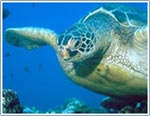
Getting to Know Ty D — the Green Sea Turtle
When he was born, Ty D Turtle was a tiny turtle! He weighed only one ounce, and his shell was only two inches long. Now that he is grown, he weighs 300 pounds and his shell is two feet long! Ty D could live to be 80 years old.
Ty D's family lives in all the world's oceans. His North American cousins live mostly in Florida, the Caribbean, and western Mexico. When he was about 5 years old, Ty D ate almost everything -- plankton, jellyfish, and fish eggs. But now, he eats mostly seaweed and loves it!
Before Ty D was born, his mother came back in the summer to the same beach where she was born to bury her eggs in the sand. She dug a big pit and laid 100 ping-pong ball sized eggs. Then she gently covered the eggs with sand and left to swim in the ocean.
One night about two months later, Ty D and his brothers and sisters dug their way out of their nest and headed quickly to the water. Light made the waves sparkle so they could see where to go.
Grown-up green sea turtles don't have many enemies. Now and then, a tiger shark eats one, but mostly they live for a long time. Babies have a rough time of it. Most of Ty D's brothers and sisters were eaten by fish, crabs, and birds. Only a few lived to grow up!
For many years in the past, people killed green sea turtles for their eggs, meat, oil, and shell. Because they grow slowly and have babies late in life, they almost became extinct in the last century.
Today, they are a Threatened and Endangered Species, so it's against the law to hunt them anymore. And around the whole world, it's against the law for countries to buy or sell turtle products or to kill, hurt, or bother them in any way.
One danger for them is getting caught in fishing lines, old fishing nets, or plastics floating in the ocean. Sometimes, they get caught in the nets of commercial fishers. But the US government has passed laws to help protect them from this.
Plastics are very bad when sea turtles eat them because they block their systems and are poisonous. Cigarette butts are also very bad for them because they can't digest the poisonous filters.
There are things you can do to help sea turtles
- When swimming, always give sea turtles at least 10 feet of space and don't block their path.
- Take part in the national beach clean-up held every September.
- Ask people to throw their cigarette butts in a trash can on the beach.
- Throw away your garbage properly.
- Reuse your plastic bags or dispose of them properly.
- Take cans, bottles, used motor oil, batteries, and newspapers to recycling centers.
- Don't release balloons into the air. They come down into the water!