
Land Risk Management Research
Relating Metal Speciation to Bioavailability in Contaminated Sediments

Projects
- Parametric Evaluation of Arsenic Adsorption and Desorption on Titanium Dioxide Nanoparticles
- Relating Metal Speciation to Bioavailability in Contaminated Sediments
- Release of Heavy Metals from Ironite
- Environmental Transport and Transformation of Nanomaterials
 r sediment.
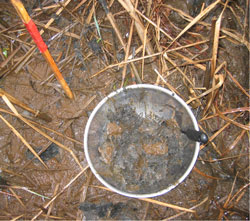
For decades, metal-contaminated sediments have been an important concern for EPA. The purpose of this research is to use spectroscopic techniques to determine the chemical speciation of metals in contaminated sediments from around the country, and correlate the metal form to biological availability via assays.
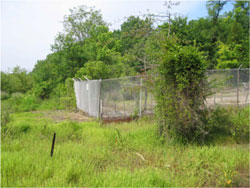
During WWI, a zinc recovery furnace was located adjacent to Mattawoman Creek at the Indian Head Naval Warfare Center in Charles County, Maryland. As a result of the recovery furnace's operation, the shore sediments of Mattawoman Creek contain zinc in the pore water at levels of 25 milligrams per liter (mg/L), and in excess of 20 grams per kilogram (g/kg) in the sediment. The goal of the Indian Head Sediments project is to develop and evaluate in situ remediation strategies for the sequestration of zinc along the shore. EXAFS performed on a sample of Indian Head sediments at Argonne National Labs in February and March 2005 identified the zinc in the sediment as zinc hydroxide, zinc carbonate, and a phase likely associated with iron.
The Chopawamsic Creek, a tributary to the Potomac River, has elevated levels of lead due to the migration of contaminated groundwater and sediment (exceeding five grams of lead per kilogram of sediment) from an erstwhile firing range.
The goal of the pilot metal sequestration project at Quantico is twofold:
- To evaluate lead speciation in sediments as related to toxicity, mobility, and bioavailability
- To evaluate the application of apatite (calcium phosphate) as a remedial strategy to sequester and immobilize lead
In the sediments, lead was found to exist primarily as a lead sulfide. In addition to the field tests, laboratory experiments investigated the chemistry of the sediments and the transport of lead to the wetland through streams characterized by high levels of iron.
Contact
Kirk Scheckel
513-487-2865
U.S. EPA National Risk Management Research Laboratory
Land Remediation and Pollution Control Division
26 W. Martin Luther King Dr.
Mail Code: CHL
Cincinnati, OH 45268