![[logo] US EPA](../gif/logo_epaseal.gif)
RCRA: Critical Mission & the Path Forward
Related Topics
RCRA Program by the Numbers
- Managing 2.5 billion tons of solid, industrial, and hazardous waste resulting from the manufacturing and use of goods throughout the economy each year
- Overseeing 6,600 facilities, with over 20,000 process units, in the full permitting universe (as reported in the 2018 strategic plan)
- Overseeing approximately 500,000 facilities that generate hazardous waste
- Working to address more than 3,700 existing contaminated facilities needing cleanup and reviewing as many as 2,000 possible additional facilities
- Providing grant funding to help states implement authorized hazardous waste programs ($97.3 million in 2013)
- Providing incentives and opportunities to reduce or avoid greenhouse gas emissions through materials and land management practices; approximately 42 percent of GHG emissions are attributable to materials management activities; approximately 16 percent are related to land management choices.
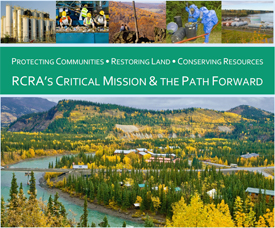
At its core, the Resource Conservation and Recovery Act is about protecting communities and resource conservation. To achieve this goal, EPA develops regulations, guidance and policies that ensure the safe management and cleanup of solid and hazardous waste, and programs that encourage source reduction and beneficial reuse. Enacted into law in 1976, the work of this national program remains critical to our environmental and economic future: there are wastes from new products and chemicals; emerging waste management technologies; unpredictable and unusual waste streams from an increasing number of natural and man-made disasters; and possible long-term legacy issues even when sites are "cleaned-up". RCRA's Critical Mission & the Path Forward (PDF) (26 pp, 3.20 Mb) details this important juncture in the RCRA program.
RCRA's mission can be divided into four main areas:
- Protect Communities and the Environment - The EPA sets comprehensive protective national standards for managing solid and hazardous waste. In partnership with the states, it ensures facilities that manage these wastes have the necessary controls to safeguard communities and the environment, while facilitating commerce by supporting an effective waste management infrastructure.
- Clean Up Land and Water - In partnership with the states, the EPA is cleaning up contaminated sites while keeping industries in business, preserving jobs and saving taxpayers’ money. The EPA is controlling and eliminating contamination at sites using short-term stabilization measures and long-term, cleanup remedies to return land and water to productive uses to support economic development and recreational uses.
- Conserve Resources - The EPA and the states advance sustainable materials management in the marketplace by working to promote use and reuse across the life cycle of materials thereby reducing the need for waste disposal capacity and minimizing the need to obtain new mineral resources.
- Partnering and Innovating - The EPA forms partnerships, uses innovative business models, electronic information systems and timely communication tools to enhance the effectiveness of the RCRA program and empower citizens to actively engage in environmental decisions that affect their daily lives, improve the health of their communities and work towards a sustainable future.
To understand where the RCRA program is now and where it is headed in the future, it is important to look at the program’s nationwide accomplishments:
- Developing a comprehensive system and federal/state infrastructure to manage hazardous waste from “cradle-to-grave;”
- Establishing the framework for states to implement effective municipal solid waste and non-hazardous secondary materials management programs;
- Preventing contamination from adversely impacting our communities and resulting in future Superfund sites by promulgating comprehensive hazardous waste regulations that include requirements to incorporate robust technical standards into waste management systems;
- Restoring 18 million acres of contaminated lands, nearly equal to the size of South Carolina, and making the land ready for productive reuse through the RCRA Corrective Action program;
- Creating partnership and award programs to incentivize companies to modify manufacturing practices to generate less waste and reuse materials safely;
- Enhancing perceptions of wastes as valuable commodities that can be part of new products, thereby conserving natural resources, saving energy, and reducing greenhouse gas emissions, through its sustainable materials management efforts; and,
- Bolstering the nation’s recycling infrastructure and increasing the municipal solid waste (MSW) recycling rate from less than 7 percent to almost 35 percent by providing information and systems that help states set recycling goals, raising awareness, and promoting the business case for waste reduction.
The RCRA program has evolved in response to changes in waste generation and management aspects that could not have been foreseen when the program was first put in place. The RCRA program is needed to address continuing challenges, including:
- highly toxic waste;
- wastes from increasingly efficient air and water pollution control devices;
- population growth that places larger demands on our natural resources; and,
- long-term stewardship of facilities that closed with waste in place.
Looking towards the future, it is important for the RCRA program to continue to fulfill its mission by:
- Continuing to safeguard communities and the environment;
- Mitigating and cleaning up contamination;
- Championing sustainable, lifecycle waste and material management approaches;
- Promoting economic development (including job creation) and community well-being; and,
- Embracing technological advances that will facilitate commerce and enhance stakeholders’ participation in the decisions affecting their communities.
More about the critical role the RCRA program continues to play in protecting communities, restoring land and conserving resources across the nation can be read in the full document RCRA's Critical Mission & the Path Forward (PDF) (26 pp, 3.20 Mb)
