![[logo] US EPA](../gif/logo_epaseal.gif)
Sustainable Water Infrastructure Systems
AED research helps managers maintain and improve natural and engineered water systems to more effectively and sustainably protect the quantity and quality of water. AED research also develops systems-based approaches to identify and manage causes of degraded water resources and promote effective protection and recovery.
Project: Green infrastructure best management practices (BMP) performance and metrics
Research task: Watershed studies on the role of green infrastructure in maintaining aquatic life use and habitat endpoints
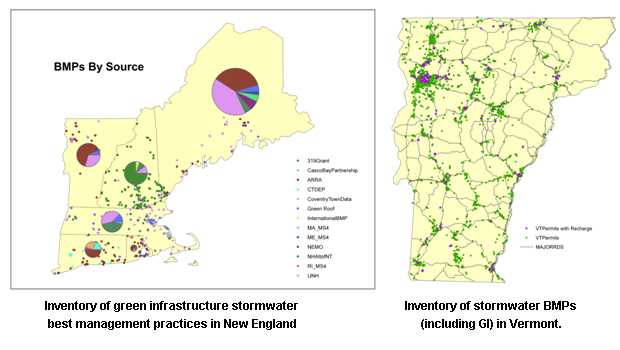
This SSWR Task applies meta-analysis, empirical analysis of local-regional scale ecological monitoring data, and retrospective modeling approaches to yield information on the effectiveness of green infrastructure (GI) best management practices (BMP) in protecting aquatic life use and instream habitat at the small watershed scale. Meta-analysis of existing case studies evaluates effectiveness of riparian buffers and stormwater BMPs in protecting stream biotic integrity. GI stormwater BMP inventories are summarized at the watershed scale for EPA Region 1 (Figure 1a,b), Delaware River, Montgomery County, MD, Austin, TX, and Chesapeake Bay. Analyses are also extended to other geographic regions/climate zones that are under-represented in current GI BMP stormwater research. Development-response relationships are modeled for comparison of predicted aquatic community and habitat with observed condition in watersheds in which GI BMPs have been implemented. In partnership with EPA Region 1 and selected communities, a decision-support tool for integrated watershed management is being developed to facilitate cost-benefit analysis of management options, including GI and low impact development (LID). Work is also coordinated with a Region 3 RARE project assessing the environmental outcomes associated with different growth strategies in Maryland and surrounding counties. Interim products culminate in an assessment report on the effectiveness of GI BMPs in protecting stream habitat and aquatic communities in multiple climate regions. This report assists managers in developing and implementing effective and sustainable GI BMP solutions.
AED Task Lead: Naomi Detenbeck
Project: Promoting safe and sustainable waters through integrated management of nutrients in New England
Aquatic resources within the Narragansett Bay watershed (lakes, rivers, wetlands, and estuaries) are being negatively affected by alterations in local, regional, and global nutrient cycles. These changes include: reduced water clarity; hypoxia; fish kills; loss of biodiversity; and increases in nuisance species. Consequently, water quality may be reduced below levels needed to meet designated uses (e.g., swimmable, fishable, drinkable), and this may also affect human well-being in other ways. Management of nutrients is a complex challenge. This research develops a systems approach that addresses nutrient problems in all aquatic habitats, from the headwaters to the Bay itself, and works with governance structures to create positive environmental change. This signature project demonstrates an approach to integrated nutrient management for the Narragansett Bay system, and provides solutions that can be broadly applied to other coastal watersheds.
AED Project Lead: Henry Walker
Research task: A systems analysis of Narragansett Bay, its watershed, and its stressors: The cumulative effects of previous management decisions on current ecosystem integrity
This task assesses past governance and management decisions in the Narragansett Bay watershed and estuary and, to the extent possible, relates those decisions to past and current ecosystem condition. This provides a first-order model, based on empirical data, that integrates with the systems-based approach of the signature project. Current system conditions in Narragansett Bay’s watershed and fresh, coastal, and marine aquatic ecosystems are evaluated through the development of a mass balance model of nutrients (N and P) for the Bay. The modeling efforts provide information on varying nutrient sources, and also apportion N and P. The current and historic impact of nitrogen on water quality is evaluated, and the relationship between nutrients and ecosystem structure and function is developed for Narragansett Bay using publically available, long-term datasets (e.g., Rhode Island trawl survey data, RI DEM seine net survey, and available data on temperature, precipitation, dissolved oxygen, pH, nutrient loading, and primary productivity). Additionally, analyses are conducted to assess ecosystem service endpoints, and the results are used to inform models relating nutrients (stressors) to ecosystem responses (ecological outcomes). These data sets and analyses provide information about: 1) spatial variations in trophic conditions among lakes and reservoirs; 2) the distribution and magnitude of hypoxic events and fish kills, invasive species, and changes in biodiversity within the Bay; and 3) data gaps. This effort supports work involving both the identification of governance decisions affecting the future trajectory of ecosystem change, and the integrated management of nutrients in this system. Lastly, in order to effectively conduct the proposed research, stakeholders are engaged, and internal and external EPA collaborators are invited to participate in this transdisciplinary research program.
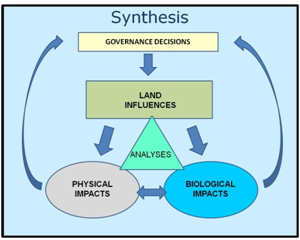
The conceptual model below shows how the pieces of the analyses will come together based on related work done for Chesapeake Bay that analyzed how changes in land activities influenced the physical and biological responses seen in the bay (Kemp, et al. 2005. Mar. Ecol. Prog. Ser. 303:1-29.).
AED Task co-Leads: Suzy Ayvazian, Marty Chintala
Research task: Determine how ecosystem structure and function are affected by drivers of change and disturbance (including climate), and by improvements related to nutrients
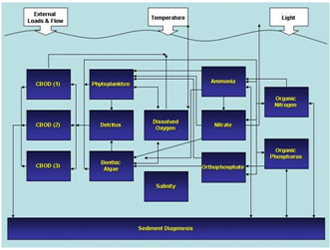
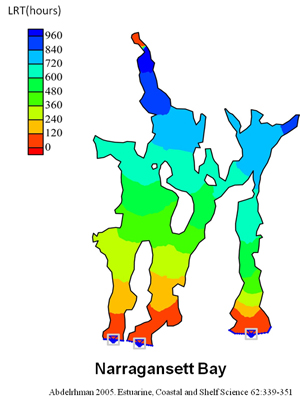
Multiple drivers, including nutrient loading and climate change, affect the Narragansett Bay ecosystem. Managers are interested in understanding the timing and magnitude of these effects, as well as ecosystem responses to restoration actions, such as the capacity and potential for restoring biology (e.g., shellfish) to ameliorate nutrient loads. Quantitative modeling is underway to predict system response to these future scenarios – we are investigating the feasibility of using linked hydrodynamic models, water quality models, and ecological models for the estuary. Selected model outputs, related to shellfish, finfish, and beaches, will be used as input for economic valuation approaches. The project is designed to assess the feasibility of using modeling to support decision-making in the context of integrated nutrient management in southern New England, with a goal of transferability to other estuaries.
AED Task co-Leads: Timothy Gleason, Brenda Rashleigh
Research task: Develop Decision Support Tools to increase sustainability in Narragansett Bay and its aquatic resources
This project serves to integrate the work conducted in the other signature project tasks into decision support tools for a few key future governance decisions and policy options surrounding sustainable water resources of the Narragansett Bay watershed, as well as its continuum of aquatic ecosystems from freshwater to the sea. More specifically, decision support tools are being developed to inform management and policy decisions affecting nutrient flux and the trajectory of change for ecosystems, communities, and economies within the Narragansett Bay watershed. We are developing a variety of decision support tools for different levels of governance; these tools incorporate and integrate monitoring data, model output, and maps which promote sustainable management of aquatic resources for all stakeholders. Two such applications will provide access to information for the Narragansett Bay Signature Project. The first is a map-based web page that provides access to spatial data that covers the geographic extent of the Narragansett Bay Watershed, including landcover, bathymetry, census, ecoregions and more.
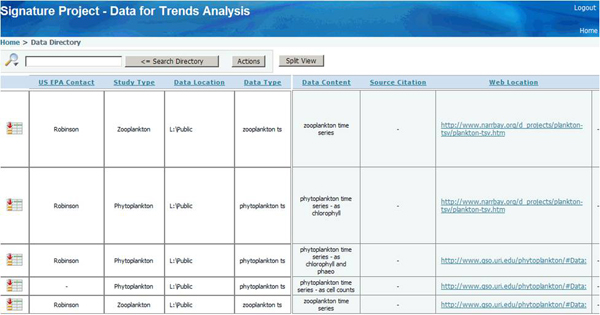
The second application is an Oracle-based directory to data that has been collected by researchers involved in the Signature Project.
AED Task Lead: Jane Copeland