![[logo] US EPA](../gif/logo_epaseal.gif)
Sustainable Water Resources
AED research identifies and develops the indicators that are most significant and effective in ensuring the sustainability and integrity of water resources. AED research also develops approaches to minimize the environmental impacts of naturally-occurring and anthropogenic contaminants, climate variability, changing human demographics, and different land use practices on the sustainability of surface and subsurface water resources.
Project: Development of core indicators of water resource integrity and sustainability as well as indicators of key drivers and pressures across a range of spatial and temporal scales for use in integrated assessments
Research task: Indicators of watershed condition and watershed attributes that promote integrity
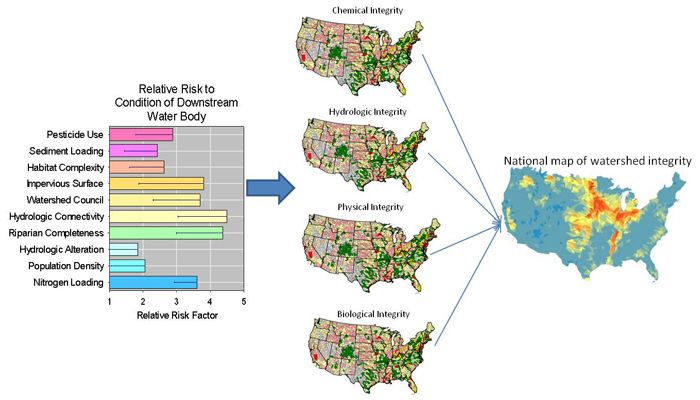
To better manage watersheds, environmental managers need spatial landscape/watershed level indicators that reflect and predict the condition and integrity of water bodies within their respective watersheds across a range of physiographic regions,. The objective of this research is to develop spatially-explicit statistical models to predict water quality, biological condition and physical habitat in streams, lakes and estuaries at state, regional and national scales. A series of indicators will be developed at multiple scales to describe key intrinsic factors controlling watershed physical processes and connectivity, and to quantify watershed-level stressors (e.g., land use alterations, climate change) that influence the condition and integrity of water bodies within watersheds.
Working collaboratively with other EPA researchers, hydrologic landscapes and functional process zones are being developed and used as foundational layers to characterize the hydrologic condition of case-study watersheds. These watershed classifications incorporate measures of climatic setting, bedrock geology, soil permeability, topography, river network characteristics and wetland distribution. AED researchers are using an integrative scalable landscape assessment approach to define watershed level stressor indicators that incorporate information on natural infrastructure and stressors, and are related to aquatic indicators based on a variety of stream, lake and estuarine condition response measures. These sets of indicators will allow environmental managers to better evaluate the stressors that are damaging the sustainability and integrity of water resources. Information from these spatial watershed level indicators will be incorporated into decisions related to preservation of watershed integrity and restoration potential at state, regional and national scales.
AED Task Lead: Anne Kuhn
Research task: Aquatic indicators of ecological condition, and approaches for diagnosis
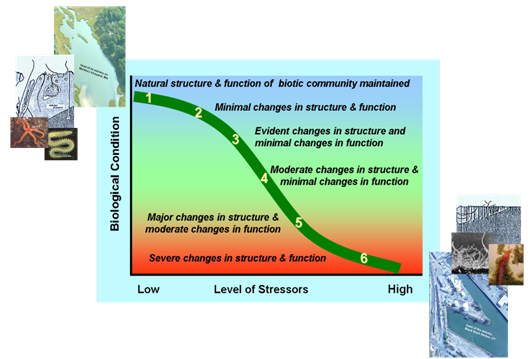
Waterbody and watershed managers need better methods to assess the biological integrity of receiving waters. This research develops an estuarine Biological Condition Gradient (BCG), providing a concrete ‘proof of concept’ for estuaries (as requested by Office of Water), and provides support for using BCG in the National Aquatic Resource Surveys. This project evaluates benthic habitats, benthic communities, and benthic habitat mosaics as ecological response indicators. Problems to be solved include how to account for estuarine gradients, how to assess communities at multiple scales, the relative effects of watershed, estuarine and oceanic processes on biological communities, and how to determine ‘reference’ or ‘minimally disturbed’ condition. This research also explores the relative importance of watershed nitrogen using stable isotopes. Together, these efforts provide improved tools for bioassessments at a range of spatial scales.
AED Task Lead: Peg Pelletier
Research task: Analytical tools for national and regional assessments
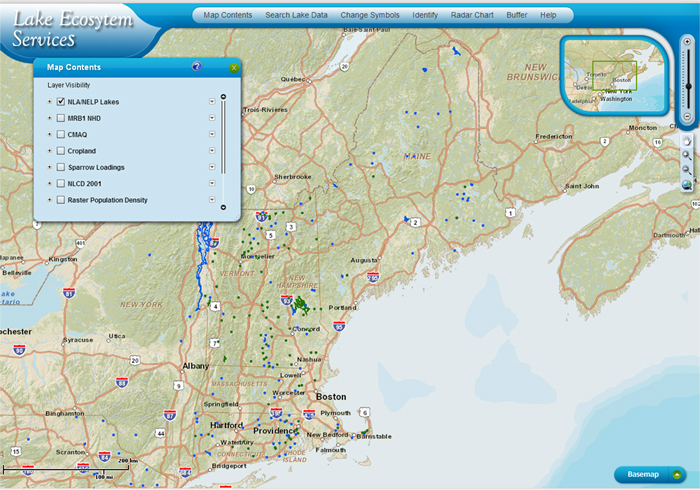
EPA’s ability to assess aquatic resources has benefitted tremendously from earlier Environmental Mapping and Monitoring program (EMAP) efforts. New electronic tools and refined approaches are needed to keep these efforts current, and to enable widespread availability of the vast amounts of data that have been collected. This task provides advisory support to the EPA Office of Water’s National Aquatic Resource Survey (NARS), and provides continued development of assessment methodologies. During the research phase of the EMAP program, AED researchers focused on assessing estuaries and lakes by devising probabilistic (random) sampling designs tailored to states’ needs, developing measurement metrics such as benthic indices, formulating procedures to manage and provide quality assurance of data, and creating tools to aid in the analysis and interpretation of survey results. Consequently, AED’s current contributions primarily involve assisting the Office of Water in NARS assessments of estuaries and lakes with regard to these same survey techniques. The AED team is reviewing the selection of metrics and thresholds used in the surveys, providing advice on improved field data collection methods, and participating in the analysis of survey data and reporting results in national reports. We are also developing Excel and R-based tools that help states access, analyze, and interpret their own survey data, and we are establishing a publicly accessible website that provides access to data, analytical aids, and GIS tools related to nutrient issues and ecosystem services in lakes.
AED Task Lead: John Kiddon
Project: Development and integration of models relating to water resource integrity and sustainability
Research task: Evaluate and develop modeling and target threshold approaches for management using Biological Condition Gradients in coral reef systems
Coastal resource managers routinely conduct biological assessments to evaluate the condition of waterbodies using direct measurements of the resident biota. This approach integrates the cumulative impacts of chemical, physical, and biological stressors on aquatic life. The Biological Condition Gradient (BCG) provides a framework to help coastal managers determine the environmental conditions that exist (assessment), decide what environmental conditions are desired (goal-setting), formulate plans to achieve desired conditions, measure management effectiveness, and communicate with stakeholders. A coastal BCG is being developed for the U.S. Caribbean (Puerto Rico and US Virgin Islands). Existing data are being used, notably from EPA’s reef assessment surveys conducted in Puerto Rico, NOAA’s reef survey and coast programs, data collected by Puerto Rico DRNA and University of Puerto Rico, supplemental data from other surveys (hydrology, sediment, and water quality, etc.), and historical information. BCG development is advancing in close collaboration with Office of Water, Office of Science and Technology, PR Department of Environmental Resources, and EPA Region 2.
AED Task Lead: Patricia Bradley
Project: Predictive tools for sustainable solutions for waterborne chemical and microbial contaminants
Research task: Tools for pharmaceuticals and personal care products in the marine environment
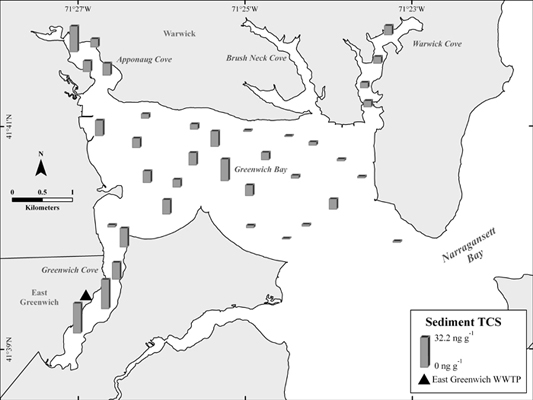
The ecological fates and effects of many pharmaceuticals and personal care products entering the marine environment are currently unknown. To address this need, our research efforts will: (1) determine the distribution, bioavailability, bioaccumulation, and toxicity of the anti-microbial emerging contaminant triclosan (TCS) to organisms in urban estuarine systems; and (2) develop methods to measure selected emerging contaminants in marine waters, sediment, and biota, and determine their toxicological effects to marine organisms. Information resulting from this research is being used to develop environmental protective regulations.
AED Task co-Leads: Rob Burgess, Mark Cantwell, Kay Ho

Blue area within Narragansett Bay represents the potential for seagrass if water clarity were sufficient to allow growth to 3 meters.
Project: Optimized solutions for sustainable nutrient management
Research task: Nutrient management for sustainability of upland and coastal ecosystems: a locally applicable management tool box for application across the US
AED is working collaboratively with colleagues from both WED and GED to improve the scientific tools that support a coherent, effective and sustainable national response to the threat of nutrient enrichment in coastal ecosystems. AED’s near-term focus is on the development of an approach to derive numeric criteria for estuaries and coastal waters of the northeastern United States. This work evaluates the relationships between nitrogen loading and hypoxia, as well as water clarity. The evaluation of various estuarine water quality and hydrodynamic models will help establish nutrient reduction goals. The application of existing Agency saltwater dissolved oxygen criteria will interpret the hypoxic goals. Much of this dissolved oxygen effort will rely on modeling, and to some degree, water-monitoring data. We also are evaluating the relationship between an integrated DO surrogate (molybdenum accumulation in sediment) and nitrogen loading, which will enhance our ability to characterize the history of dissolved oxygen concentrations over large spatial and temporal scales. Unlike DO, consistent water clarity goals do not currently exist. Calibration for Narragansett Bay (and eventually for other regions of the Northeast) of an existing bio-optical model will help set those water clarity goals and aid in establishing restoration objectives for seagrass. The successful completion of this task will offer States in New England a set of modeling tools to contribute to establishing estuarine water quality standards for nutrients.
AED Task Lead: Glen Thursby
Research task: Satellite remote sensing of chlorophyll a for assessing water quality responses to nutrients in the Neuse and Tar-Pamlico River (NC) estuaries
This effort seeks to identify time periods and locations along the Neuse and Tar-Pamlico River estuaries where the North Carolina (NC) water quality standard for chlorophyll a is exceeded. The NC chlorophyll a standard serves as the foundation of the nitrogen total maximum daily load (TMDL) for the Neuse River estuary and is also applied to the Tar-Pamlico River estuary. Using satellite imagery (~300 m pixel resolution) from the Albemarle-Pamlico estuary system provided by the European Space Agency Medium Resolution Imaging Spectrometer (MERIS) sensor, and previously acquired data, the magnitude and extent of chlorophyll a is estimated at multiple temporal and spatial scales. Statistical analyses (mean, median, and 90th percentile values) of weekly, regional scale chlorophyll data are conducted to determine periods of TMDL exceedances and NC water quality standards violations along the Neuse and Tar-Pamlico Rivers from 2006-2009. Products from this research include a database and maps of satellite chlorophyll a for multiple estuaries, with distribution and quantitative estimates of chlorophyll a criterion exceedances of the TMDL limits and NC state standards, together with an evaluation of remote sensing technology to support compliance monitoring for nutrient criteria.
AED Task Lead: Darryl Keith

Photo Credit: https://www.flickr.com/photos/stefe/1330274590
Research task: Cyanobacteria, nutrients, and land use - a nexus for sustainable water resources and human health protection
This task integrates research on the ecology, epidemiology, toxicology, and economics of cyanobacteria. Specific areas addressed include: 1) the relationship between nutrient flux, water quality, and landscape structure and the prevalence of cyanobacterial blooms; 2) analysis of mammalian toxicology and potential human health consequences of cyanotoxin exposure; 3) development of biomarkers for cyanotoxin exposure, and 4) an analysis of nutrient management, human health risks, and loss of ecosystem services related to cyanobacteria blooms. A key product is an online tool that synthesizes research results, and provides access to data, maps, and/or tools.
AED Task co-Leads: Betty Kreakie, Jeff Hollister