![[logo] US EPA](../gif/logo_epaseal.gif)
Landscape-scale Assessments
Extent, Properties, and Landscape Setting of Geographically Isolated Wetlands in Urban Southern New England Watersheds
Geographically isolated wetlands, or those completely surrounded by upland, are increasingly being excluded from protection under the Clean Water Act. In light of this, information on the location and functional significance of geographically isolated wetlands is needed to inform the ongoing debate on the degree to which these wetlands should be protected and restored. Unfortunately the vast majority of geographically isolated wetlands have yet to be identified and mapped, and there is a need to assess their presence, extent, and properties. This is particularly true in urban watersheds, where wetlands may be at greater risk of becoming isolated as a result of habitat fragmentation through urbanization.
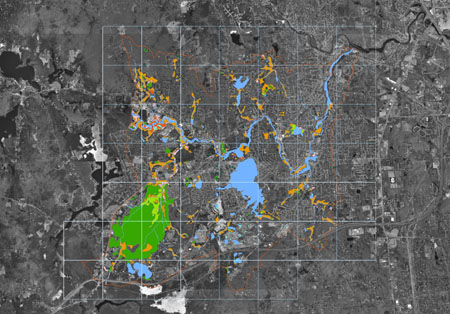
In this study we assessed the extent and characteristics of geographically isolated wetlands in a series of watersheds in the urban northeast U.S. We applied a previously developed index of urbanization to a sample of 10 watersheds selected at random from a set of 30 watersheds whose boundaries lay within the borders of Rhode Island, USA. The index of urbanization in our sample watersheds ranged over more than an order of magnitude and increased with increasing amount of urban land use in the watersheds (r2 = 0.51, F = 8.22, p = 0.02). The density of isolated wetlands in the watersheds averaged 1.93 ± 0.21 wetlands km-2 and comprised 38.2 ± 1.77 % of all wetlands. Isolated wetlands were smaller than those connected to other waters (non-isolated), and accounted for 6.01 – 16.5 % of the total wetland area in the watersheds. The area of isolated wetlands as a percent of all wetland area significantly increased with increasing watershed urbanization (r2 = 0.62, F = 12.9, p = 0.007). Isolated wetlands were predominantly deciduous forested wetlands, and urban land cover in the 50 m buffer surrounding isolated wetlands was significantly higher than in the 50 m surrounding non-isolated wetlands. The proportion of urban land cover was greater in a 150 than a 50 m buffer surrounding the wetlands. Our results suggest that an increase in the index of urbanization of 50 will result in 7% of the watershed’s wetlands being lost from federal protection. These findings indicate that the process of urbanization, along with accompanying habitat fragmentation, may result in an increase in the vulnerability of wetlands to loss and degradation and therefore has implications for the management and conservation of geographically isolated wetlands.
Results are summarized in McKinney, R.A., and M.A. Charpentier. Extent, properties, and landscape setting of geographically isolated wetlands in urban southern New England watersheds. Wetlands Ecology and Management, DOI 10.1007/s11273-008-9110-x.